|
|
|
Monday, June 20th, 2016
It’s amazing to me, but looking back over more than a decade of writing I find posts that still impress, with information that is as useful now as when it was written. Golden Oldies is a collection of what I consider some of the best posts during that time.
We all know change is the only constant, but is change linear? Does everyone see changes the same way? Does it even matter? And if it does matter, how does it affect your work as a manager? Read other Golden Oldies here
 The other day I said to a friend that I’ve turned into a real wimp. He thought I was kidding and said that I was the last person he associated with wimping out on anything. The other day I said to a friend that I’ve turned into a real wimp. He thought I was kidding and said that I was the last person he associated with wimping out on anything.
I was surprised, but as we discussed it I realized that what I saw as wimpiness he saw as strength.
That got me to thinking how often what one person calls wimping out may be another person’s greatest act of courage. Likewise, what moves one person can leave another cold.
It’s all relative depending on your MAP, the circumstances and even the mood you’re in.
Sounds obvious, but it’s important knowledge, not information, but knowledge—maybe even wisdom—for any person responsible for motivating others, whether at work or in everyday life.
Image credit: nookiez CC license
Posted in Golden Oldies, Motivation, Personal Growth | No Comments »
Monday, February 29th, 2016
It’s amazing to me, but looking back over nearly a decade of writing I find posts that still impress, with information that is as useful now as when it was written. Golden Oldies is a collection of what I consider some of the best posts during that time. Read other Golden Oldies here.
Are you and original or crowdsourced?
I’ve always been an original, much to my family’s consternation when I was growing up and to friends, bosses and colleagues since.
Being an original isn’t the easy way to go. It’s far more comfortable to be a copy; to follow without question the ideology, religion, parents, friends—anyone or anything that takes away the fear of making the wrong choice.
I don’t remember feeling scared as I careened through my early life taking sometimes crazy risks, but never without doing worst case analysis first.
I even adopted Frank Sinatra’s My Way as my personal theme.
FRANK SINATRA – MY WAY (FROM THE ROYAL FESTIVAL… by Mukhran
For what is a man, what has he got?
If not himself, then he has naught.
To say the things he truly feels;
And not the words of one who kneels.
The record shows I took the blows –
And did it my way!
Do you have a theme for your life?
Or do you need to ask your friends?
Posted in Golden Oldies | No Comments »
Monday, January 25th, 2016
It’s amazing to me, but looking back over nearly a decade of writing I find posts that still impress, with information that is as useful now as when it was written. Golden Oldies is a collection of what I consider some of the best posts during that time. Read other Golden Oldies here

I’m no happier about the AIG and other bonuses paid to screwed up Wall Street banks, but I’m not sure why any of us are surprised.
“In the largest 25 corporate bankruptcies between 1999 and 2002, while hundreds of billions of dollars of investor wealth and over 100,000 jobs disappeared, the Financial Times found the “barons of bankruptcy” made off with $3.3 billion.”
Giant compensation packages, guaranteed bonuses and platinum parachutes are excused by Boards and executives as necessary to attract the “best and brightest,” but here’s what’s really going on.
The ‘name’ demands outsize compensation/stock options/guaranteed bonus/etc. in order to validate their ‘brand’.
Those responsible for hiring not only meet the demands, but even exceed them in an effort to attain or sustain the company’s reputation as a better home for ‘stars’—the more stars you have the greater the bragging rights— mine’s bigger than yours in high school locker room talk.
Now let’s consider the folly of this attitude.
Those hiring often seek a name brand in the mistaken belief that the brand comes with a warranty that guarantees good results.
But no matter who you hire you’re actually paying for their past performance, which is always influenced by
- circumstances—boss and company positioning in its market and industry
- environment—culture and colleagues;
and let us not forget that minor factor
The hiring mindset is that everything the brand accomplished was done in a total vacuum and dependent only on the brand’s own actions, therefore changing every single surrounding factor will have no impact on performance.
Put like that it sounds pretty stupid, doesn’t it.
This is one of the prime reasons that so many CEOs bring their ‘own team’ over when they move, as do managers all the way down the food chain—they know they didn’t do it alone.
CEOs aren’t like movie and rock stars whose very names draw consumers into spending money—nobody ever bought a product from GE because Jack Welch was CEO, nor do they carry Jobs’ iPods—so why pay them that way?
Moreover, assuming that performance occurring during an expansion is a valid yardstick for performance in general, let alone a downturn, is sheer idiocy.
You have only to remember the difficulties faced by people whose management skills were honed between 1991 and 2000, the longest expansion in our history. When the recession hit in March of 2001 they had no experience whatsoever of how to drive revenue or manage in a down economy.
That recession and the previous one in 1990 lasted only 8 months each. The longest recession we’ve had was 2 years, January-July 1980 and July 1981-November 1982, and that one had a 12 month break in it. This means there are a very small number of managers with any actual experience managing in anything even close to what’s happening now.
The current recession officially started in December 2007, so it’s already 15 months old and the end isn’t in sight.
What experience makes these folks the ‘best and brightest’ for today’s world?
Just what the hell are companies still guaranteeing oversized compensation and exorbitant exit packages when now is definitely the time to pay for future performance—no guarantees.
Sad, isn’t it. Seven years and nothing’s changed, in fact, it’s gotten much worse.
The wealth of the richest 62 people grew by more than half a trillion dollars in that last half-decade, while the wealth of the poorest 50 percent of people globally decreased by more than $1 trillion during the same period.
Image credit: flickr
Posted in Compensation, Golden Oldies, Hiring | No Comments »
Friday, November 13th, 2015
A Friday series exploring Startups and the people who make them go. Read all If the Shoe Fits posts here
 Why is it that we assume the people in our own little bit of world see/do/think as we do. Why is it that we assume the people in our own little bit of world see/do/think as we do.
Think about it.
Do you assume that when faced with choices they will choose as you would?
Do you assume the visions presented by your leaders are honest, true and in your best interest?
Do you assume your religious leaders practice what they preach?
Do you assume your spouse/partner/friend will like the movie/book/people that you like?
Do you assume your team will tackle work/projects in the same way you do?
Think about it.
For any of these assumptions to be true, the people involved would have to have exactly the same MAP and life experience that you have—which is impossible.
So the next time you find yourself assuming stop and remind yourself that they are not you.
Image credit: HikingArtist
Posted in If the Shoe Fits, Personal Growth | No Comments »
Thursday, October 22nd, 2015

Sanity is waxing, while funding craziness is waning
This means you will be working even harder than you have been to move your vision forward.
With money getting tighter does that mean you should grab whatever funding available?
Short answer, NO — getting in bed with an investor should signal a long-term relationship, not a hook-up.
Longer answer, NO because…
All angels and seed investors are not created equal and it’s not the difference in money.
It’s the difference in MAP.
Money is only part of what you want from an investor.
Active interest, mentoring and contacts are what your investors should bring.
These are especially important with early-stage investors.
Just as important is a synergy between your values and the values of your initial investors, since values are what underlie your startup’s culture.
For example, if your values include a focus fairness, diversity and social give-back a la Salesforce and your investor’s values are strictly focused on minimizing costs to increase profits the relationship will be rocky, to say the least.
How do you know?
Smart founders do lots of due diligence and talking with founders of previously funded startups, whether they succeeded or failed.
Yes, it’s hard to say ‘no’ when the money is on the table.
But easier if you remember that while refusing funding may slow you down, taking it from the wrong person can kill you.
Flickr image credit: Michael Lehet
Posted in Culture, Entrepreneurs | No Comments »
Thursday, October 1st, 2015

I wrote the original of this post five years ago and posted this follow-up three years ago.
Considering the media frenzy around the lifestyles of tech CEOs I thought it was time to post it again.
A couple of years ago I wrote a post about leadership that included a quote from the main character, a forensic anthropologist, in the TV show Bones.
Anthropology tells us that the Alpha male is the one with the crown, the most shiny baubles, the fanciest plumage, but I learned that the real alpha male is often in the shadows because he is busy shining the light on others.
Founders are typically alphas, whether male or female.
With that in mind I have a simple question to ask you.
Which kind of alpha are you?
Read the original post and then decide.
If you don’t like your answer choose to change.
There’s always a choice.
Flickr image credit: Tambako The Jaguar
Posted in Entrepreneurs, Personal Growth | No Comments »
Friday, May 15th, 2015
A Friday series exploring Startups and the people who make them go. Read all If the Shoe Fits posts here
One of the hardest things that founders/startups face is the need to grow up and stop shooting from the hip.
I hear the reasons not to all the time
- It will ruin our culture.
- It stifles creativity.
- It’s for larger companies.
- It’s bureaucratic.
- It’s too time consuming.
“It” refers to the underpinnings of all successful companies. “It” includes the following, or variations thereof, in order of importance:
- Financial controls that include, but are not limited to
- monthly statements of revenues by product;
- discounts;
- costs by department;
- cost of customer acquisition;
- stock issuance;
- cash flow;
- hiring by department
- Hiring process
- Annual operating plan covering the above financial measures
- Organization charts and definitions of responsibilities
- Long-term planning
- Centralized information technology implementation and planning
Whether it’s just you, or one, ten, fifty, or more employees, whether full time, part time or virtual, you need viable processes to keep you focused—think of it as coloring inside the lines.
Everything on this list can, and should, be tailored to your business model, but financial controls of one sort or another and a good hiring process are necessary to any business.
Sure, they can’t all be implemented at once, but none of them will happen as long as your MAP rejects or begrudges them—after all, you’re the founder and people will follow your lead.
Finally, don’t confuse process with bureaucracy.
Process is like MAP, it gets you where you want to go, whereas bureaucracy stifles whatever it touches.
Process, like MAP, is ever-growing, while bureaucracy is carved in stone.
Image credit: HikingArtist
Posted in Culture, If the Shoe Fits | No Comments »
Thursday, April 30th, 2015
 Fact: culture stems from manager MAP (mindset, attitude, philosophy™). Fact: culture stems from manager MAP (mindset, attitude, philosophy™).
Fact: there are two basic, unconscious attitudes that underlie MAP.
- “TaIk to me, I don’t know everything;” or
- “Shut up and do what I say; my vision, my way.”
Know which you are — brutally honest inside your head.
If you are the first then it should be a critical factor when hiring (easy to confirm when checking references).
If the second applies be prepared for higher attrition.
It’s your choice.
Image credit: Grace Keogh
Posted in Culture, Entrepreneurs, Personal Growth | No Comments »
Monday, April 27th, 2015
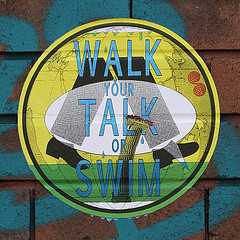
Having trouble getting people to do things differently or do something new?
According to Henry Thoreau, “Things don’t change, people do.”
Over the years, I’ve watched managers and companies try to change the outcome without changing the input.
They’ve talked/explained/begged/pleaded/threatened, but nothing changes.
They are suffering from Einstein’s version of insanity.
Doing the same thing over and over again and expecting different results.
If change is the goal, it’s best to start with yourself.
“To change what they do, change how you think.”
You need to change because the way you think, what you think, how you think, and what you believe — in other words your MAP — dictates the authenticity of what you do and the responses you get.
No matter what great ideas you read, hear or talk, no matter what great leader you try and channel, you will always walk your own MAP.
Image credit: Newtown graffiti
Posted in Change, Personal Growth | No Comments »
Monday, April 20th, 2015

Do you equate leadership to influence?
Does being labeled an “influencer” by LinkedIn or other social media make you a leader?
Not really.
True leadership is internal.
It’s a function of your MAP (mindset, attitude, philosophy™).
It starts by knowing both yourself and your MAP.
Knowing yourself refers to knowing what you’ve done.
Knowing your MAP means knowing why you did it.
Knowing both allows you to accurately evaluate where you are and where you’re going.
That knowledge is the rudder with which you can chart and achieve any course you choose.
Image credit: Jevgenijs Slihto
Posted in Personal Growth | 2 Comments »
|
 Subscribe to
MAPping Company Success
About Miki 
Clarify your exec summary, website, etc.
Have a quick question or just want to chat? Feel free to write or call me at 360.335.8054
The 12 Ingredients of a Fillable Req
CheatSheet for InterviewERS
CheatSheet for InterviewEEs™
Give your mind a rest. Here are 4 quick ways to get rid of kinks, break a logjam or juice your creativity!
Creative mousing
Bubblewrap!
Animal innovation
Brain teaser
The latest disaster is here at home; donate to the East Coast recovery efforts now!
Text REDCROSS to 90999 to make a $10 donation or call 00.733.2767. $10 really really does make a difference and you'll never miss it.
And always donate what you can whenever you can
The following accept cash and in-kind donations: Doctors Without Borders, UNICEF, Red Cross, World Food Program, Save the Children
*/
?>About Miki
About KG
Clarify your exec summary, website, marketing collateral, etc.
Have a question or just want to chat @ no cost? Feel free to write
Download useful assistance now.
Entrepreneurs face difficulties that are hard for most people to imagine, let alone understand. You can find anonymous help and connections that do understand at 7 cups of tea.
Crises never end.
$10 really does make a difference and you’ll never miss it,
while $10 a month has exponential power.
Always donate what you can whenever you can.
The following accept cash and in-kind donations:
|