|
|
|
Archive for the 'Communication' Category
Tuesday, March 31st, 2020

The chatter about how AI will change the world, take your job, out-consult the consultants, displace management, perform reviews, identify potential criminals and reoffenders, diagnose illnesses, etc., especially etc., is never ending.
AI is supposed to bring true objectivity to its many applications creating longed for change.
Yet it’s been proven over and over that AI contains the same biases that created our unfair, prejudiced world; not just in the US, but around the world.
AI is good at increasing bias in the name of efficiency and objectivity.
It is even better at automating the loss of privacy and increasing surveillance in the name of safety.
Long before AI got hot Lou Gerstner knew the solution.
Computers are magnificent tools for the realization of our dreams, but no machine can replace the human spark of spirit, compassion, love, and understanding.
Something tech has forgotten in its love affair with data and its warped view of progress.
And, of course, profit.
Image credit: safwat sayed
Posted in Communication, Culture | No Comments »
Wednesday, March 11th, 2020
As we saw yesterday, business is learning the hard way that walking their corporate responsibility talk is vital to their very survival.
They aren’t the only ones out of touch.
John C. Williams, the president of the Federal Reserve Bank of New York, said in a speech last month that “there is still time to avert this fate.” Moving inflation up and keeping it there could convince millennials, he said.
“In this case, it’s fortunate that the young are impressionable.”
“Fate” refers to the potential economic mayhem that could result from the high savings rate among Millennials looking to retire ASAP. “Impressionable?” I wonder how long it’s been since he actually knew any of the “young.”
Powerful men who have seen women as things to do with as they please are thinking twice in the wake of #metoo and Harvey Weinstein’s conviction. Hopefully that caution will trickle down to the rank and file bosses who still seem untouchable, although that’s unlikely.
Big Tech is no longer seen a solution to the world’s problems, but, in many cases, as their cause.
Startups are learning that public investors, whether knowledgeable or casual, are still hung up on mundane ideas like profit as opposed to their beloved EBITDA.
Founders, too, are rethinking their actions. Thanks to high profile cases, such as Travis Kalanick (Uber) and Adam Neumann (WeWork), and a much savvier workforce, visions and charisma are no longer enough.
One might look at all this and say, “the world is changing,” although a more realistic view could be summed up as “too little, too late.”
Image credit: CHRISTOPHER DOMBRES
Posted in Communication, Culture, Personal Growth, Politics | No Comments »
Tuesday, March 10th, 2020
I wrote yesterday’s Oldie back in 2007; it ended with this comment,
Corporate responsibility is a major buzzword these days, but it’s hard to tell whether it’s tied more closely to
- doing what’s right;
- doing what you can get away with; or
- not getting caught.
It’s taken 13 years for practitioners of the second and third approaches to even consider changing.
The pressure they face to take such steps is real; the industry’s years of reliance on hypocrisy, lobbying, and misleading public relations tactics is eerily reminiscent of the approach taken by tobacco companies, and its litigation risks are set to follow a similar trajectory, with lawyers and activists framing failure to address climate change as a human-rights violation.
The changes certainly aren’t being driven by the Feds (consider the EPA’s decision to limit scientific research when drafting environmental and public health regulations), but by people.
The corporate responsibility façade is—finally, thankfully—crumbling. Activist investors and angry citizens have forced a reckoning. The Conference Board views the upcoming 2020 proxy season as a tipping point for disclosure of corporate political activity.
Even more potent are Gen Z’s and many Millennial’s attitude on choosing a place to work.
Young graduates evaluating prospective employers know that the true narrative of a corporation’s purpose can be found by reviewing who it does business with and which politicians it backs [emphasis mine].
There is no company that can survive without an adequate workforce and there is no Generation in history as suspicious and downright cynical about corporate America, including Big Tech, unicorns and startups in general than Gen Z — an attitude already infecting other generational segments.
Amazon employee reaction to CEO Jeff Bezos’ climate change initiative is a good example.
Amazon Employees for Climate Justice responded to Jeff Bezos’s recent $10 billion commitment to fight climate change by reminding their CEO that “one hand cannot give what the other is taking away.”
That two-faced approach isn’t unusual; in fact, it’s common practice — more plainly described as talk the talk, but screw the walk.
It will be difficult for that approach to continue working when it seriously limits recruiting efforts, not to mention paying customers.
Image credit: Frits Ahlefeldt
Posted in Communication, Culture, Ethics, Hiring, Retention | No Comments »
Tuesday, February 11th, 2020

Yesterday included a post about how tech has sold itself as the silver bullet solution to hiring people.
Algorithms actually do a lousy job of screening resumes and companies that rely on them miss a lot of great hires.
Why?
Because the only thing an algorithm can do is match key words and experience descriptions. Based on 13 years of tech recruiter experience I can tell you that rarely does anyone change jobs in order to do the same thing somewhere else, unless they hate their manager or the culture.
Not things that an algorithm is going to pick up on. Nor will the initial phone call usually made not by the hiring manager, but by someone who know little about the job other than to match the candidates responses to a list of “preferred” answers.
No discretionary knowledge based on the manager’s experience or the candidate’s potential.
We all know that management loves to save money and many of them feel that AI will allow them to reduce the most expensive item of their fixed costs, people — including managers.
Imagine an app giving you a quarterly evaluation—without a manager or HR rep in sight—and you have an idea of where this is potentially going.
What management forgets is that a company isn’t an entity at all. It’s a group of people, with shared values, all moving in the same direction, united in a shared vision and their efforts to reach a common goal.
It exists only as long as people are willing to join and are happy enough to stay — excessive turnover does not foster success.
So what do workers think about the use of AI/algorithms?
However, workers don’t necessarily like the idea of code taking over management functions—or hiring, for that matter. Pew research shows 57 percent of respondents think using algorithms for résumé screening is “unacceptable,” and 58 percent believe that bots taught by humans will always contain some bias. Nearly half (48 percent) of workers between the ages of 18 and 29 have some distrust of A.I. in hiring, showing that this negative perception isn’t going away anytime soon.
They are right to be distrustful, since AI is trained on historical datasets its “intelligence” includes all the bias, prejudices, bigotry and downright stupidity of past generations.
This is bad news for companies looking to “increase efficiency,” but great news for companies that recognize they aren’t hiring “resources” or “talent,” but people, with their infinite potential and inherent messiness.
Image credit: Mike MacKenzie
Posted in Communication, Culture, Hiring, Motivation, Retention | No Comments »
Tuesday, December 17th, 2019

A recent article in Wired focused on the industry claim, amplified by the media, that driverless cars will be a boon to seniors — not that any of them were asked.
Not only are the claims that these systems might help older people overblown, they’re also made, for the most part, without including those older people in studies of the effects of the technology.
What a joke. If you claimed to design a better surfboard, but had never surfed, people would be more than skeptical.
This is a common cycle in technology, more broadly. Over and over again, designers claim their products will be great for an aging population without actually including that population in the conversation. “I think there’s been a lot of new technologies being marketed toward older adults but that haven’t necessarily been designed for them, with their capabilities in mind,” Wendy Rogers, a professor at the University of Illinois, told me for an episode of my podcast Flash Forward. (…)
In many cases, such products were designed by younger people with little sense of what seniors actually need. “So, the buttons are small, the voice quality is not easy to hear, the number of steps required to set it up to get it to do what you want to do is complicated,” Rogers told me. “There are a lot of apps out there, things that are supposed to support pain management, for example, and they’re just not designed well for older adults.”
One of the best examples of bad design is found in most alarms, such as smoke alarms and carbon monoxide monitors. They all have one thing in common, the sound they emit is usually high-pitched, which is pretty useless, since high frequencies are the first to go; not just in old people, but in middle age and younger.
A friend in the geriatric field told me that nursing homes and assisted living facilities often have trainees smear a light coating of Vaseline on their glasses. Functioning all day (or longer) gives them a much better understanding of what many seniors deal with all the time.
You would think companies would be more interested in the reactions of their target market, but when that market is seniors, companies see no need to ask, since they know best — especially true when technology is involved.
There seems to be an assumption, conscious or not, that as joints stiffen brains do, too. And I’m sorry to say it is much worse in younger males.
And younger males are the guys who get funded first.
Do you see a problem here?
Image credit: foundin_a_attic
Posted in Communication, Innovation | No Comments »
Wednesday, December 4th, 2019

In all my years of reading Wally Bock’s Three Star Leadership Blog I have never come across an iota of unnecessary complication, convoluted advice, negativity, or BS in any form. Just solid common sense and usable how-to’s. Monday you met a good boss and yesterday one of the worst, today is some advice from Wally on how to become a Monday-style boss.
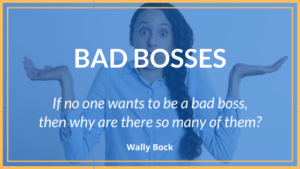 Nobody gets up in the morning and decides they’re going to go into work and be the worst boss on the planet. So, why are there so many bad bosses? Nobody gets up in the morning and decides they’re going to go into work and be the worst boss on the planet. So, why are there so many bad bosses?
Depending on the research you read, between 1/2 and 2/3 of all bosses are ineffective. Most of them aren’t mean, or abusive, they’re just bad at the job. That research was done a few years ago, but I don’t think things have changed much. It’s the system, silly.
The System Creates Bad Bosses
Bosses are people who are officially responsible for the performance of a group. We expect them to accomplish a mission through the group and care for group members.
Alas, we promote people who give no evidence that they have the skills to do that job or have any desire to do it. You wouldn’t hire someone as an accountant because he or she was a good plumber. But we do that all the time with bosses. We promote people to group responsibility because they’re good at something else. That something else might be making sales, designing marketing campaigns, or writing code. It usually doesn’t include the things we want bosses to do.
You might ask, “Why do people take a position they don’t want and probably won’t be good at?”
That answer’s simple. In too many companies, becoming a boss is the only way that you can get more money and prestige. If it’s the only route available, people will take it.
We could fix this easily. Allow people who might become bosses to try on the job in a temporary assignment. That way the company learns who has the aptitude and desire for a boss’s job. And people learn whether they’ll enjoy the work.
Great. We give bunch of people a job they have no aptitude or desire for. We call it a promotion, but it’s more like a career change. What do we do next?
We compound the problem. Once you become a boss in most companies, you can’t go back to being an individual contributor. You’re stuck. For the rest of your career, you’re going to be miserable doing a bad job that affects the lives and productivity of dozens of people.
Then we compound the problem one more time. We dump people into that new career without much training or support.
Lots of Bosses Don’t Know What Being A Good Boss Looks Like
We build up our mental model of what a good boss is by experiencing a good boss. Too many people who get promoted haven’t had one. They have no idea what it’s like to be a good boss or how different it is to be on a team with a good team leader.
This is a chicken and egg problem. You need good bosses to set the example and help others imagine what being a good boss is like. And you can’t use the negative examples of bad bosses. Bad bosses may teach you what not to do, but they can’t teach you what to do instead.
Good Bosses are Effective Coaches
You want bosses who are coaches, mentors, and encouragers of people who want to do a similar job. That means training bosses in coaching and development skills. It means tying some of their compensation to the work they do developing people. It means basing their promotion, in part, on how effective they are developing good leaders.
The Transition is Critical
We must provide special support during the two years from the time a person is promoted. That means readily available materials, coaching, and coursework.
Deliver training in small bites not a three-day program that covers everything. Deliver training before a person assumes the job, not six months later. By then he or she has developed a bunch of bad habits. Supplement with coaching to transfer skills from the classroom to the workflow.
New bosses will come back from training with a head filled with good ideas about what to do. Then, those ideas slam into reality. Doing is a lot harder than knowing.
That’s when coaching is vital. They need to learn in small, doable steps that build confidence. The best place to get that is from their boss, who’s also a great coach.
Bottom Line
We have a system in most companies designed to produce too many ineffective bosses. We need to fix the system. Meantime pay special attention to coaching. Give potential leaders some experience of the job before they accept it. We can make sure the bosses we have understand new leader development as part of their job and have the skills to do it. We need to remove leaders who aren’t effective, so they don’t continue to affect performance and morale.
Image credit: Three Star Leadership
Posted in Communication, Leadership, Personal Growth | No Comments »
Tuesday, December 3rd, 2019
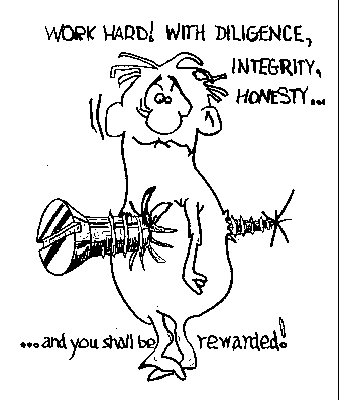
A long time ago I wrote about what I call ego-merge, which refers to buying into the idea that you and your company are one.
Ego-merge used to be the result of long-term employment with the same company; these days it’s more the result of buying too deeply into the founder’s vision.
“The initial thing of ‘making a life, not a living,’ ‘community,’ ‘better together’ — the terms WeWork pushed as marketing also seeped into this company’s culture in a very real way,” said Kevin Hsieh, a software engineer involved in the group. “There is a looming sense of betrayal and frustration that that wasn’t necessarily followed everywhere.”
Betrayal is no understatement.
Adam Neumann, WeWork’s CEO, walked away with a $1.7 billion golden parachute, while employees are getting worse than screwed.
Combining an intriguing vision, with intense passion and an invincible belief in self, is a recipe that can hook investors, workers and users — and it did.
Caveat emptor, indeed.
Posted in Communication, Culture, Personal Growth | No Comments »
Monday, December 2nd, 2019
Poking through 11+ years of posts I find information that’s as useful now as when it was written.
Golden Oldies is a collection of the most relevant and timeless posts during that time.
This post is from 2014, but layoffs are again in the news. Almost every day another company talks about cost-cutting and rumors start to fly. Contrary to what you might think, there is a right way and a wrong way to handle a layoff.
Read other Golden Oldies here.
A Friday series exploring Startups and the people who make them go. Read all If the Shoe Fits posts here
The need for a layoff can happen to any company of any age or size, but most companies and managers bumble the task and end up doing far more damage than necessary.
The damage is not just to those laid off, but also to those left behind, themselves and the company.
As most of you have read, Cheezburger Networker just laid off a third of its staff, but great credit goes to CEO Ben Huh for bending over backwards to do it with the least damage possible.
-
- He cut his vacation short when he realized what had to be done, as opposed to delegating it and staying away until it was over.
- He was honest, open and candid with his entire staff, thus avoiding the kind of rumors that typically circulate.
- He did everything possible to ensure those laid off found new positions, including personally reaching out to other companies and setting up his own job fair.
In short, he did everything I recommended in 2008.
I only know of one manager who got his jollies laying people off (he always tried to do it just before Thanksgiving or Christmas) and he was, without doubt, a sadist.
Most managers, like Huh, find them to be tremendously emotional and not at all fun.
“Often, when faced with a problem, you want to run in the other direction. It’s like seeing a lion in the jungle. But I have to do what is best for the company, even if it sucks emotionally.”
There’s one more required action after a layoff and that’s dealing with the empty space, which can’t be ignored, but can be done positively without spending big bucks.
Image credit: HikingArtist
Posted in Communication, Golden Oldies | No Comments »
Monday, November 25th, 2019

Poking through 13+ years of posts I find information that’s as useful now as when it was written.
Golden Oldies is a collection of the most relevant and timeless posts during that time.
80 years ago Dave Packard commented that good management was “marked by personal involvement, good listening skills and the recognition that “everyone in an organization wants to do a good job.” That belief developed into a management technique called MWBA and it’s just as powerful now as it was then — if not more so. 13 years ago I wrote a four-part series about it. The second post talks about why to do it, the third about uncovering problems and the fourth about using MWBA to crosscheck what you hear.
And yes, you do have time.
Author John le Carré, of Bond fame, said it best.
“A desk is a dangerous place from which to view the world.”
Read other Golden Oldies here.
Remember Management By Walking Around (MWBA)? It’s an oldie, but a goodie.
Great managers work to spend at least 25% (or more) of their time wandering around chatting and building trust with their people.
Don’t have time? Maybe that’s because you never really thought abut the benefits. Getting to know your people this way helps you to
-
- spot high-potential workers;
- raise your trust quotient with employees;
- improve retention;
- attract talent;
- discover molehills before they’re mountains, and, most importantly, it’s the best, if not only, way to
- know what’s really going on.
To work it must be the norm—that means it needs to be done constantly, not just when there’s a problem.
Consistent, casual visits make people feel comfortable and encourages them to chat—saying what they are thinking without editing it. To pass on information, rumors, and the like without wondering or worrying that it will boomerang and hurt them.
While wandering, you’ll hear enough to validate or repudiate what you heard from somewhere else. It lets you protect your sources—which means they’ll continue to pass on information—and it helps you avoid acting on erroneous information.
The higher you rise in the organization the more important this intelligence becomes. One of the greatest dangers for any manager is getting isolated and hearing only a sanitized or slanted version of what’s going on within the group, department or company. This is especially true for the CEO and senior staff.
Bottom-line—get off your duff, out of your office, wander around, say hi, listen, be a sponge and soak it all up.
Invest the time—that’s what managers do—and it will pay off handsomely!
Does it still work? Absolutely. Read about how it went from strictly a management tool to also offering personal growth and stress reduction.
A note for managers in love with tech. MBWA can’t be done digitally; it’s an in-person, face-to-face technique that works.
It takes far less time than recruiting new people.
And it’s free.
Image credit: LYCS Architecture on Unsplash
Posted in Communication, Culture, Golden Oldies, Leadership, Retention | No Comments »
Wednesday, November 13th, 2019
Men have been bosses since the dawn of work.
Therefore, by whatever name, reviews have been a male province.
For decades reviews have been hell.
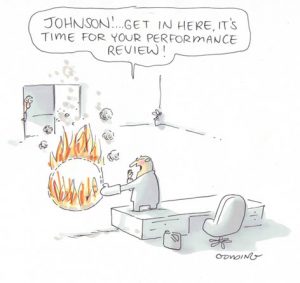
And in many companies they still are.
Image credit: Hiking Artist
Posted in Communication, Culture, Retention | No Comments »
|
 Subscribe to
MAPping Company Success
About Miki 
Clarify your exec summary, website, etc.
Have a quick question or just want to chat? Feel free to write or call me at 360.335.8054
The 12 Ingredients of a Fillable Req
CheatSheet for InterviewERS
CheatSheet for InterviewEEs™
Give your mind a rest. Here are 4 quick ways to get rid of kinks, break a logjam or juice your creativity!
Creative mousing
Bubblewrap!
Animal innovation
Brain teaser
The latest disaster is here at home; donate to the East Coast recovery efforts now!
Text REDCROSS to 90999 to make a $10 donation or call 00.733.2767. $10 really really does make a difference and you'll never miss it.
And always donate what you can whenever you can
The following accept cash and in-kind donations: Doctors Without Borders, UNICEF, Red Cross, World Food Program, Save the Children
*/
?>About Miki
About KG
Clarify your exec summary, website, marketing collateral, etc.
Have a question or just want to chat @ no cost? Feel free to write
Download useful assistance now.
Entrepreneurs face difficulties that are hard for most people to imagine, let alone understand. You can find anonymous help and connections that do understand at 7 cups of tea.
Crises never end.
$10 really does make a difference and you’ll never miss it,
while $10 a month has exponential power.
Always donate what you can whenever you can.
The following accept cash and in-kind donations:
|