Rather repeat the same stuff I’ve been saying for the last 11 years, consider what John Hall, co-founder and president of Calendar, says.
… workers aren’t liable to fall in love with a company over a handful of gimmicks and perks. … the things that really matter when it comes to sticking with an employer for a long time go deeper than decorations.
What are they?
Well, they aren’t rocket science — except to bosses whose heads are stuck in the past.
Yesterday focused on the constant opportunities that surround us as we move through our lives.
But in order to take advantage of them you need to be willing to move outside your comfort zone.
It’s always easier to coast than it is to climb.
In the same way, it’s easier to play it safe with what you already know than to put yourself in the position of being uncomfortable and having to learn new stuff — and possibly look foolish or fail
So what if you do?
The world won’t stop turning, nor will a lightening bolt materialize and strike you. Oh. And the sky won’t fall.
I promise.
What will happen is you’ll learn, grow, get braver, and your interests will expand.
And practically a guarantee that you’ll go further in life than you would have otherwise.
A Friday series exploring Startups and the people who make them go. Read allIf the Shoe Fits posts here.
Regular readers know I have a thing for CB Insight’s co-founder Anand Sanwal and the newsletter he writes. The great data is a given, but the real draw for me are his common sense and wicked sense of humor, both of which infuse his prose creating an irresistible combination.
Monday’s newsletter shared a contrarian view of failure taken from his presentation at last year’s at SaaStr.
Acknowledging and being ok with failure is one of the best things about the startup community. We now celebrate the act of writing a startup failure post-mortem as courageous. (…) Most are vapid puff-piece post-mortems that talk about being too early to market or suggest investors weren’t committed or offer up trite discussion of why they’ve joined a “larger platform” whose vision aligns with theirs.
Once again Anand is my hero by saying stuff out loud that needs to be said.
I’ve always believed that failure is a learning opportunity, but I never thought it should be enshrined and lauded.
Any more than Mark Zukerberg’s “move fast and break it” should have become a startup mantra.
Jean M. Twenge, author of The Narcissism Epidemic: Living in the Age of Entitlement. “But the ‘everybody gets a trophy’ mentality basically says that you’re going to get rewarded just for showing up. That won’t build true self-esteem; instead, it builds this empty sense of ‘I’m just fantastic, not because I did anything but just because I’m here.’”
That attitude permeates everything else, so why should Startupland be any different?
The heart of a champion is measured not by their victories but by how they come back from defeat.
I may not have mentioned it before, but I am a University of Georgia grad and proud to be a Bulldawg!
My beloved college football team went into double overtime and defeated Oklahoma in this year’s Rose Bowl. That win propelled them to compete in the National Championship next week against Alabama. This is the first time in 38 years since UGA has competed for the title and I’m excited to see how they do.
Why do I bring this up you may ask? Well, for one thing, I am taking every chance I get to celebrate the great season my team is having. The second reason is that the current news is absolutely depressing and tends to drag me down.
One goal for the new year is to surround myself with positive people and mindsets. The news doesn’t fit into that.
I previously brought up failure and how it can transform or destroy someone. As mentioned, I attended UGA and graduated with a degree in Economics. One of the required courses was Finance 300, all business majors had to have it and it wasn’t the easiest of courses. I enrolled and about midway through I realized I was going to fail the class. Not even close to a C, a solid F.
I had a choice to make then and there. Stop attending and sleep in ( it was and 8am class) or continue on with zero stress, absorb and study and then retake it in the summer. I chose the latter and was very happy about it.
My professor saw that I continued attending and partaking in the class and I built a relationship with him. As a student it was great, I felt like I was auditing the class and was not worried about grades. When the summer rolled around I was able to master the course and finished with a B+.
I actually still look back at that time with fondness, even years later.
So much of our life can be full of regret, why not embrace the failure and learn from it?
I attended a tech talk recently that was put on by the Tampa Bay Tech Garage here in Tampa, FL. Like most mid sized cities we have some thriving tech companies as well as startups.
The tech garage is an incubator that provides mentoring, work spaces and community to those that are growing their businesses. One way they facilitate this is by hosting talks with well established owners who can speak to their trials and successes, all in an effort to grow the tech community in our area.
Side note: if your reading this and you’re cold then consider the Tampa/St Petersburg area, it’s warm, full of sun and has a thriving community.
The discussion I attended centered on how failure is inevitable, but creates innovation and break-throughs if approached in the right way.
Our speaker was Chad Nuss, CEO of Inside Out, a sales innovation lab that teaches, tests and optimizes sales teams across the country. He had been the owner of several startups with successful exits and is just a great guy to be around. In his different roles he has also experienced epic failures that he had to learn from.
The topic was relevant in a lot of ways.
In tech we tend to say that revenue covers a multitude of sins. The evidence is there when you look at the Ubers or [insert any other money-losing company] of the moment.
Successful people also have epic failures, but if they are generating revenue it shouldn’t matter.
This is the wrong approach! It leads to us brushing off failure, burying our head in the sand and not learning. It is one reason you see companies have spectacular rises and sudden falls.
There is a better way.
Examining a failure in your life can be humbling, but also rewarding. You can learn from it, approach it differently next time, or achieve a breakthrough.
As I look at my own life I can count the many ways I have failed and repeated that same mistake again. I actually do not mind failing but I hate repeating that.
How often have you achieved a breakthrough or innovation after a failure?
What did you learn and how did you make it better?
As we go forward we shouldn’t fear failure, we should embrace it and grow.
I am in sales and as a result I have a ton of metrics that I must account for. How many calls did I do? What is my conversion rate? Are you having a prospecting or velocity issue with closing deals? Is your sales funnel robust enough?
I think you get the idea. These and many other metrics are all important as they can lead to a greater success as you iterate.
By most accounts sales is easy to measure the successes and failures. It’s like sports, who has the most points at the end of the game?
Culture though can be a bit tougher to measure. It’s not a tangible good and as I consider the subject I wonder how can we best measure it?
It’s pretty easy to see the extremes of company cultures and see if they are positive or negative.
Uber had been in the news a lot lately, even their president stepped down after saying they did not align with his values.
On the other hand Google landed the top spot again by glassdoor.com with their annual best places to work.
With a little thought you can see one culture is more negative and the other is pretty positive.
Those are fairly easy examples, but what about all the thousands of other companies in small towns and cities? How do we know if they are indeed a positive place to be and what metrics should we use to measure?
I worked for one company that ranked as a top workplace in the local metro area. This was touted by its recruiters and quite frankly was a selling point for me when I came on board. I had had a terrible experience in a previous company and I was ready for a change!
However, after some time of working at my new place we were given the opportunity to participate in the annual survey that would measure top workplaces.
This poll was, in reality, mandatory and we had to provide so much demographic data that it was very easy to determine who had filled out what survey.
The result was we all wrote very positive reviews and then we were voted top workplace again. I believe the total is four years in a row at this point.
I bring this up as an example of how one metric, annual best workplace surveys, could be wildly skewed and may not be the best metric to utilize.
Where else should we turn to measure? Pay could be a factor of course. Tenure and turnover are factors too.
I had a teacher in college tell me to always ask my interviewer what the turnover for employees under two years was. He felt this was a good measure of the health of the company and the role I was pursuing.
I still ask that question and have found that when turnover is high, culture is low.
At this point I don’t have a silver bullet and will do more research to see if there is a magic quadrant we should be seeking.
I’ll update you next week on whether someone a whole lot smarter than me already did the tough work, or if I stumbled onto a way to start a company measuring culture that is the new hot thing in town.
It’s amazing to me, but looking back over more than a decade of writing I find posts that still impress, with information that is as useful now as when it was written.
Golden Oldies is a collection of what I consider some of the best posts during that time.
During his time at GE, Jack Welch was lauded and crowned as a god of leadership and management— How times have changed. Welch’s success was dominantly a function of GE’s financial services and he created one of the harshest cultures around—which would have failed miserably with today’s workforce.
There is a sizable difference between accepting positional leadership when a company is at the bottom and there is no place to go but up and taking over when its at its height—even more so when what was the growth engine and source of extraordinary profits disappears from the economic landscape.
It is one thing to maximize what you have, wringing out every last possible dollar, and investing in innovation for sustainable growth in the future.
It is one thing to create a culture where public shame and the likelihood of termination for missing your numbers rules and changing that to a culture that encourages appropriate risk-taking and never kills the messenger when the risk doesn’t pan out; a culture that understands not every innovation will be a home run, but encourages and applauds the effort anyway.
These are the differences between Jack Welch and Jeff Immelt.
Welch had taken over when the company was in the bottom of an economic cycle. He took over GE in a recession, not at the height of a bubble.
Immelt got the job right after the end of the high-flying 1990s, an era which crowned CEOs with mythical, God-like crowns, and Welch was bestowed the biggest of them all.
Immelt had known before the meltdown the company needed to wean off the leveraged risk from finance that was begun under Welch. … He admitted mistakes, as any good leader must do, and GE more quietly if not humbly went about its business in making the company a 21st century sustainable and reliable profit engine.
How many times have you heard founders say similar things?
Yup, it reads like a generic laundry list of the reasons “why startups fail.”
And they end the post with a fervent Valley paean to failure.
At Cards Against Humanity, we believe that you can only become a master by trying and failing. In this way, failure is life’s greatest teacher; failure is actually success. At Cards Against Humanity, we fail all the time. We are veterans of failure. And constant failure, plus unlimited capital, is what led us to greatness.
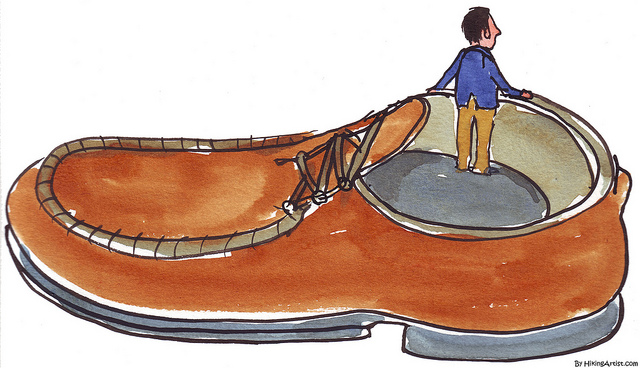
Now you know why this post is called “if the shoe fits”…
There’s a lot of talk these days from consultants, academics and executives about the importance of transparency, AKA being totally open and honest.
And many of those in the business world, from team leaders through CEOs, are actually walking the talk.
Or believe they are.
The problem lies in the fact that even those executives who have opened operations, especially financials, to the internal scrutiny of their people don’t recognize that true transparency needs to be a two-way street.
One-way transparency is open to spin — whether intentional or not.
Which, if you stop to think about it, should come as no surprise. It is a normal, human characteristic to put the best face on even the most negative thing.
So how is true, two-way transparency achieved?
By opening yourself to a no-holds-barred Q&A with everybody and forcing yourself to provide the A no matter how uncomfortable.
President Obama broke with convention back in 2012 when he agreed to do an Ask Me Anything — AMA — on the Internet forum Reddit.
But if you think it takes guts to expose yourself to a half hour of inquiries from strangers on the web, try fielding regular sessions of no-holds-barred questions from your own employees — live and on camera. Welcome to our normal routine: the internal AMA.
… While facing questions from my team is tough when I’m in the hot seat, it’s become a crucial tool for building trust as we’ve scaled from hundreds to more than a thousand employees.
I doubt you’ll find a lot of executives willing to do it, because a true AMA isn’t exactly fun for those in the hot seat, as Finkelstein freely admits, but it’s a great way to build trust, ownership/engagement, eliminate fear, etc.
There are plenty of times when I’ve been caught entirely off-guard. But that’s precisely the point. The element of surprise is the secret ingredient that makes the internal AMA such a valuable tool. (…)
Creating a culture where it’s safe to ask literally anything can lead to some awkward moments, but just taking that step helps instill a sense of ownership at every level. Sitting in that hot seat might make you sweat, but that just means you’re doing it right.
Entrepreneurs face difficulties that are hard for most people to imagine, let alone understand. You can find anonymous help and connections that do understand at 7 cups of tea.
Crises never end.
$10 really does make a difference and you’ll never miss it,








 You could be a
 Image credit:
 There is a sizable difference between accepting positional leadership when a company is at the bottom and there is no place to go but up and taking over when its at its height—even more so when what was the growth engine and source of extraordinary profits disappears from the economic landscape.
 At Cards Against Humanity, we believe that you can only become a master by trying and failing. In this way, failure is life’s greatest teacher; failure is actually success. At Cards Against Humanity, we fail all the time. We are veterans of failure. And constant failure, plus unlimited capital, is what led us to greatness.


