|
|
|
Wednesday, February 6th, 2019

One of the major reasons people ghost isn’t rocket science.
Nor is the major cause.
Candidates ghost because nothing connected — not the company, culture, job, people, and especially not the hiring manager.
Employees ghost because they aren’t engaged.
They feel that nobody — boss, company, colleagues — gives a damn so why should they.
And in many cases they are correct.
Companies don’t walk their cultural talk, low morale is obvious, as is a “me before thee” attitude, and
for a variety of reasons, bosses treat people as replaceable — even when they know it won’t be easy or could take months.
It’s nothing new.
Since the day people became hires, instead of slaves or indentured, bosses have used and abused them.
They still do, but on a more refined level.
Skipped promotions, demotions with little-to-no explanation, seriously brutal layoffs by email, with no warning (as Elon Musk just did), which is especially destructive to people when the company/job has been cast as some kind of “higher calling,” as is common in the tech world.
Candidates often fare no better.
Many managers consider hiring a necessary evil — resumes bore them, they hate wasting time interviewing — and they have more important things to do.
Strangely enough, HR often acts the same way, with preliminary interviews conducted by interviewers who look for word matches between resumes/candidates and job descriptions.
Obviously, it’s not all companies or all bosses — but likely the ones that get ghosted.
Image credit: Joe Le Merou
Posted in Communication, Culture, Hiring, Motivation, Retention | No Comments »
Monday, February 15th, 2016
It’s amazing to me, but looking back over nearly a decade of writing I find posts that still impress, with information that is as useful now as when it was written. Golden Oldies is a collection of what I consider some of the best posts during that time.
Unengaged workers was a growing problem long before I wrote Who Cares in 2011and it has escalated since then. The results of a January Gallup poll show 67.5% of US workers are unengaged and the reason at the end of this post still holds true. Read other Golden Oldies here.
 I’m hearing the same lament from a lot of managers these days; the words and circumstances are different, but it boils down to the same thing—s/he has the knowledge, but doesn’t do anything. I’m hearing the same lament from a lot of managers these days; the words and circumstances are different, but it boils down to the same thing—s/he has the knowledge, but doesn’t do anything.
It’s not just younger workers, but all ages.
The current term is “unengaged” and the problem is rampant.
Most managers who call don’t use that term, they complain that people just don’t care. They don’t care about doing more than the minimum; they don’t care about doing great work, instead of just adequate; they don’t care how the company is doing; the list of ‘they don’t care’ goes on and on.
They all see this as a problem with the people they hire.
They ask me where to source good candidates; how to better interview, so they can hire “people who give a damn.”
Some complain that the so-called entitled attitude of Millennials has spread to all ages.
These managers are a disparate group; they come from different industries and range from management newbies to senior executives, but they all have one thing in common.
None of them sees “not giving a damn” as a result of the way they manage, but 98% of the time it is.
So the next time someone you know (or you) complains about people not caring, suggest they ask the only person who really knows the answer—the one they will find in the mirror.
The old adage “you reap what you sow” holds just as true for bosses and companies as in any other circumstances.
Flickr image credit: antkriz
Posted in Golden Oldies, Motivation, Personal Growth, Retention | No Comments »
Tuesday, September 1st, 2015
 Gallup regularly polls workers around the world to find out. Its survey last year found that almost 90 percent of workers were either “not engaged” with or “actively disengaged” from their jobs. Think about that: Nine out of 10 workers spend half their waking lives doing things they don’t really want to do in places they don’t particularly want to be. Gallup regularly polls workers around the world to find out. Its survey last year found that almost 90 percent of workers were either “not engaged” with or “actively disengaged” from their jobs. Think about that: Nine out of 10 workers spend half their waking lives doing things they don’t really want to do in places they don’t particularly want to be.
Pretty sad, but what happened to bring us to this sorry state?
Not what, but who.
Disengagement was born in 1776 with Adam Smith wrote Wealth of Nations, became the father of industrial capitalism, and gave birth to the belief that “people were naturally lazy and would work only for pay.”
The more that philosophy was embraced over the centuries the more it became a self-fulfilling prophecy — in other words, people live up or down to expectations.
An excellent essay by Barry Schwartzauga, professor of psychology at Swarthmore College, provides great insight to how much damage has been done by this one assumption.
When money is made the measure of all things, it becomes the measure of all things.
To be sure, people should be adequately compensated for their work. (…) But in securing such victories for working people, we should not lose sight of the aspiration to make work the kind of activity people embrace, rather than the kind of activity they shun.
For decades, study after study and survey after survey have placed money (assuming a living wage) around number five on what’s important to workers.
How can we do this? By giving employees more of a say in how they do their jobs. By making sure we offer them opportunities to learn and grow. And by encouraging them to suggest improvements to the work process and listening to what they say.
Work that is adequately compensated is an important social good. But so is work that is worth doing. Half of our waking lives is a terrible thing to waste.
Autonomy. Challenge. Learning and growth. The chance to make a difference. Compensation.
If you want your people engaged then provide them reasons to engage.
If not, just pay them and don’t complain.
Flickr image credit: Airwolfhound
Posted in Compensation, Culture, Ducks In A Row | No Comments »
Wednesday, March 18th, 2015
I’m not a lover of the so-called 1099 economy, primarily because I think the concept and the unicorns it’s spawned have been successful at gaming the system — so far.
But that’s unlikely to last.
More importantly, a company called Managed by Q is proving it doesn’t need to.
Managed by Q provides on-demand cleaning services for offices using an iPad, which it installs for free, and also offers other services like restocking the fridge or office supplies. With on-demand and subscription services for customers — and now 150 cleaners in New York — its services have become pretty popular: They’re used by other startups like Flatiron Health, Elite Daily, and Uber.
Managed by Q hires its “operators,” as it calls them, as employees, offering full-time and part-time employment with benefits and stock options. The work is flexible, and Managed by Q works with operators’ schedules.
I find it ironic that Uber, poster child of the 1099 model, hires a company that proves you can make money and still do traditional hiring, treat all employees well, draw investment and make money.
I’ve said it before and will continue saying it because it’s true, a company is like a three legged stool with investors, customers and employees being the legs. If one leg is longer or more robust than another the stool will tip over.
Managed by Q is part of the minority of on-demand services that is paying attention not just to its clients, but to the people carrying out its day-to-day work. And that’s what sets it apart.
Sets it apart, gives people a future, isn’t looking at lawsuits and seems to have missed the startup greed train.
All I can say is read the article and three cheers for Q, the anti-1099 heroes.
Image credit: Yelp
Posted in Compensation, Hiring, Motivation | No Comments »
Tuesday, November 11th, 2014
 Ask most managers and they’ll tell you that they understand their team’s goals and concerns. They see themselves as in sync with their people. Ask most managers and they’ll tell you that they understand their team’s goals and concerns. They see themselves as in sync with their people.
But are they?
Based on a study about stress the difference in perception of cause between workers and managers is more a chasm than a rift.
But what was particularly striking about the findings was the disconnect between what employees and managers perceived: Inadequate staffing was cited by 53% of workers as the major reason for stress, while only 15% of senior managers thought this was so. A third of managers said that access to technology outside of working hours was a cause of stress, but workers disagreed, with only 8% citing it.
Disconnects between managers and workers are never good, but when the subject is something l like stress it can have a major impact on the bottom line.
Stress lowers productivity, hurts creativity and innovation, increase absenteeism, leads to health problems, thus raising health care costs
In short, stress causes and escalates disengagement.
Of those employees claiming high stress levels, 57% said they were disengaged. In contrast, just 10% with low stress levels said they were disengaged.
Obviously, being out of sync with your people costly to both your company and to you, personally.
Join me tomorrow for a look at getting back in sync and other useful information.
Flickr image credit: Fabio Luiz
Posted in Culture, Ducks In A Row, Retention | No Comments »
Tuesday, September 23rd, 2014

When I’m writing for a client I lose track of time; I don’t even notice when someone walks into my office.
It’s called being “in the zone” and it happens when you are seriously interested and deeply engaged with what you are doing.
Mihaly Csikszentmihalyi, a psychologist at the Claremont Graduate University, has been studying this latter phenomenon for decades. He calls it flow: the experience we have when we’re “in the zone.” During a flow state, people are fully absorbed and highly focused; they lose themselves in the activity.
It’s a proven fact that self-control is mentally fatiguing, but new research shows that high interest results in lower mental fatigue.
Bosses who use contests and gamification to drive interest are missing a good understanding of today’s workforce—and it’s not about age or even self-interest.
People get interested because a project is meaningful and they can see how their work contributes to the larger picture.
Even on minor projects they can see how what they did helped achieve the outcome.
No busy work; no incomplete information and no doing [whatever] for the sake of doing it.
In short, if you want to generate interest in a task it must be meaningful and provide an opportunity for the worker to add value.
Flickr image credit: Beverley Goodwin
Posted in Ducks In A Row, Personal Growth | No Comments »
Tuesday, July 29th, 2014
As the women on Whisper say, and American Apparel’s Dov Charney proves, sexual harassment is alive and flourishing.
I mention that in case you are from off-planet.
But sexual harassment comes in another package; one that’s strictly hands-off.
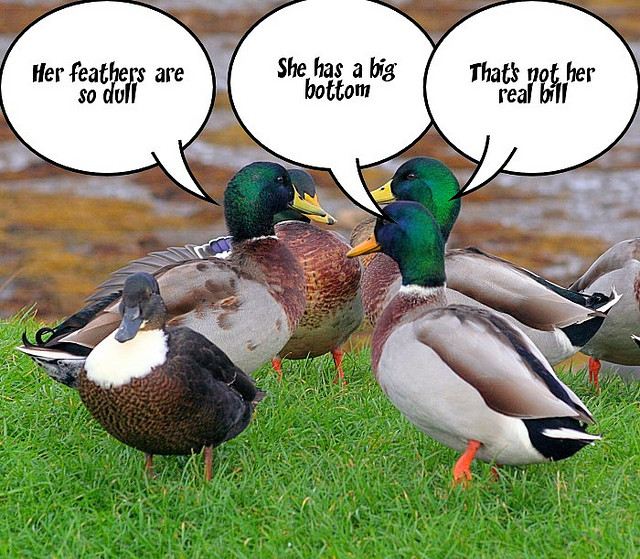
It’s called gossip.
Because gossip usually revolves around looks, shape, weight and body characteristics, along with who someone is seeing and what they are doing.
Discussion of any of these subjects in the workplace will create a hostile environment.
Hostile environments lower worker focus, engagement and productivity.
Which many bosses don’t seem too concerned about, since they are often active/passive gossip participants.
They would care more if they had the ability to understand cause and effect, which seems to be a disappearing brain function (but that’s another post).
So in the name of better workplaces I’ll spell it out in easily understandable terms.
Gossip contributes to hostile, as well as just plain crappy, work environments.
Bosses who participate, facilitate or benignly neglect gossip will see the effect in employee turnover.
They will feel the effect in their own lowered compensation.
And they definitely deserve both.
Flickr image credit: John Haslam
Posted in Culture, Ducks In A Row | 1 Comment »
Monday, December 9th, 2013

A few years ago I asked why companies thought they could cut pay, benefits and hours and still expect their workforce to stay engaged and give a damn about the company’s success.
The answer, of course, is they can’t and the employees don’t.
Even as they cut pay and hours, retailers that sell “value pricing” still expect people to buy.
A good example is Wal-Mart, long known as the poster child of low compensation and king of the part-time workforce.
But in earnings calls the blame is on the costs that are going up with no mention of wages going down.
“Their income is going down while food costs are not,” William S. Simon, chief executive of Wal-Mart, said of the company’s customer base. “Gas and energy prices, while they’re abating, I think they’re still eating up a big piece of the customer’s budget.”
And down it has gone.
Adjusted for inflation, the national minimum wage reached a peak in 1968 and has lost about 6 percent of buying power since it was last raised in 2009.
I sometimes think Henry Ford was the last executive who understood that you can’t run a consumer economy if the consumers aren’t paid enough to buy stuff.
Ford astonished the world in 1914 by offering a $5 per day wage ($110 today), which more than doubled the rate of most of his workers. (…) The move proved extremely profitable…
Obviously, Wal-Mart has never had an executive who understood that simple principle.
Congress doesn’t either.
Simon says income is going down, but apparently he can’t make the connection between that and his company’s actions.
Simon and his ilk know that people need disposable income to buy stuff, but for that to happen they need to stop treating their people as disposable.
Flickr image credit: Bernard Pollack
Posted in Compensation | 1 Comment »
Tuesday, July 5th, 2011
I’m hearing the same lament from a lot of managers these days; the words and circumstances are different, but it boils down to the same thing—s/he has the knowledge, but doesn’t do anything.
It’s not just younger workers, but all ages.
The current term is “unengaged” and the problem is rampant.
Most managers who call don’t use that term, they complain that people just don’t care. They don’t care about doing more than the minimum; they don’t care about doing great work, instead of just adequate; they don’t care how the company is doing; the list of ‘they don’t care’ goes on and on.
They all see this as a problem with the people they hire.
They ask me where to source good candidates; how to better interview, so they can hire “people who give a damn.”
Some complain that the so-called entitled attitude of Millennials has spread to all ages.
These managers are a disparate group; they come from different industries and range from management newbies to senior executives, but they all have one thing in common.
None of them sees “not giving a damn” as a result of the way they manage, but 98% of the time it is.
So the next time someone you know (or you) complains about people not caring, suggest they ask the only person who really knows the answer—the one they will find in the mirror.
Flickr image credit: antkriz
Posted in Ducks In A Row, Motivation, Personal Growth | 10 Comments »
Tuesday, December 7th, 2010
 Did you ever think that having excellent strategic vision, confidence and communication skills can hurt your ability to create an inclusive culture, instead of guaranteeing it? Did you ever think that having excellent strategic vision, confidence and communication skills can hurt your ability to create an inclusive culture, instead of guaranteeing it?
Great cultures require a high level of trust between employees and management. People who are highly competent and confident of their direction and actions can come over as arrogant and insensitive—not traits that encourage trust.
You don’t have to hide your vision, confidence and communication skills to alter negative perceptions; you just need to add some additional ones.
Here are three MAP (mindset, attitude, philosophy™) actions that go a long way to making that great culture you want a reality.
- Good culture is engaging; accomplish this by involving all your people at all levels—the more involvement the better.
- Good culture is about listening—not talking.
- Good culture is about hearing—and being willing to change when appropriate.
Involve, listen, hear; do them now; do them constantly and watch your culture bloom.
Flickr image credit: http://www.flickr.com/photos/zedbee/103147140/
Posted in Culture, Ducks In A Row | No Comments »
|
 Subscribe to
MAPping Company Success
About Miki 
Clarify your exec summary, website, etc.
Have a quick question or just want to chat? Feel free to write or call me at 360.335.8054
The 12 Ingredients of a Fillable Req
CheatSheet for InterviewERS
CheatSheet for InterviewEEs™
Give your mind a rest. Here are 4 quick ways to get rid of kinks, break a logjam or juice your creativity!
Creative mousing
Bubblewrap!
Animal innovation
Brain teaser
The latest disaster is here at home; donate to the East Coast recovery efforts now!
Text REDCROSS to 90999 to make a $10 donation or call 00.733.2767. $10 really really does make a difference and you'll never miss it.
And always donate what you can whenever you can
The following accept cash and in-kind donations: Doctors Without Borders, UNICEF, Red Cross, World Food Program, Save the Children
*/
?>About Miki
About KG
Clarify your exec summary, website, marketing collateral, etc.
Have a question or just want to chat @ no cost? Feel free to write
Download useful assistance now.
Entrepreneurs face difficulties that are hard for most people to imagine, let alone understand. You can find anonymous help and connections that do understand at 7 cups of tea.
Crises never end.
$10 really does make a difference and you’ll never miss it,
while $10 a month has exponential power.
Always donate what you can whenever you can.
The following accept cash and in-kind donations:
|