|
|
|
Tuesday, March 12th, 2019
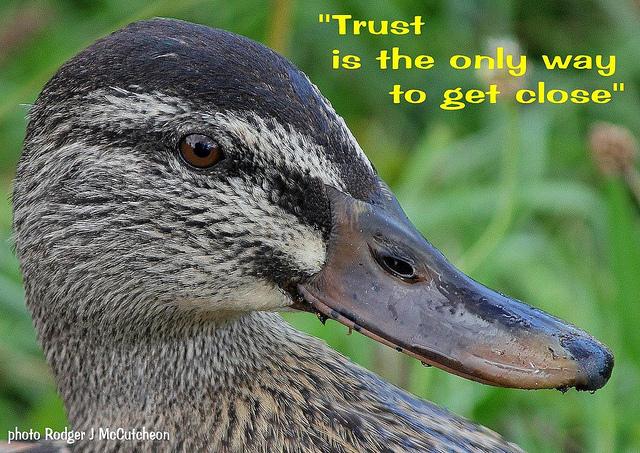
Yesterday’s Oldie was a reminder that there are very view motivators that can beat VSI (vested self-interest) when it comes to engaging your team.
Some people respond to money, but many more respond to intangible rewards.
How do you know what works?
How can you tailor motivators individually for each person?
I’ve heard from bosses at every level that they’re already stretched, they need to focus on the deliverables and their team and just don’t have the time to deal with individuals.
Which is laughable, since the team is comprised of individuals and the bosses job is to engage and motivate them, so the deliverables are delivered on time.
Great managers have no fear of using one of the most efficient approaches, i.e., ask your current team and each new hire.
Don’t suggest or use multiple choice, just ask.
- What makes you eager to come to work?
- If you could choose just one thing, other than compensation, that would light your work fire what would if be?
Don’t ask in a group situation if you want real answers, honest answers.
In fact, don’t ask in person, since you may not be able to control your initial reaction. If that happens it will break trust with that person and it is unlikely to be rebuilt any time soon.
Remember, this isn’t about what motivates you, nor is it any business of yours to judge what motivates someone else.
Hand the questions out in hard copy with each person’s name already on it.
Tell them you are using hardcopy to avoid the chance of accidental leaks and promise their responses won’t be shared with anybody.
It is extremely important that you don’t share them, even anonymously, with anyone, especially inside the company. Doing so for any reason, with anyone is betrayal, pure and simple.
Explain that because all humans are different you want to understand what really matters to each of them and that once you do you’ll do your best to provide it.
Finally, don’t kid yourself, if you don’t honor your promise it is betrayal, the equivalent to sleeping around when in a committed relationship.
If you don’t know how to be faithful, you’re better off just forgetting about this post.
Image credit: Auckland Photo News
Posted in Culture, Ducks In A Row, Motivation, Retention | No Comments »
Wednesday, February 6th, 2019

One of the major reasons people ghost isn’t rocket science.
Nor is the major cause.
Candidates ghost because nothing connected — not the company, culture, job, people, and especially not the hiring manager.
Employees ghost because they aren’t engaged.
They feel that nobody — boss, company, colleagues — gives a damn so why should they.
And in many cases they are correct.
Companies don’t walk their cultural talk, low morale is obvious, as is a “me before thee” attitude, and
for a variety of reasons, bosses treat people as replaceable — even when they know it won’t be easy or could take months.
It’s nothing new.
Since the day people became hires, instead of slaves or indentured, bosses have used and abused them.
They still do, but on a more refined level.
Skipped promotions, demotions with little-to-no explanation, seriously brutal layoffs by email, with no warning (as Elon Musk just did), which is especially destructive to people when the company/job has been cast as some kind of “higher calling,” as is common in the tech world.
Candidates often fare no better.
Many managers consider hiring a necessary evil — resumes bore them, they hate wasting time interviewing — and they have more important things to do.
Strangely enough, HR often acts the same way, with preliminary interviews conducted by interviewers who look for word matches between resumes/candidates and job descriptions.
Obviously, it’s not all companies or all bosses — but likely the ones that get ghosted.
Image credit: Joe Le Merou
Posted in Communication, Culture, Hiring, Motivation, Retention | No Comments »
Wednesday, August 29th, 2018

What do the companies with the best customer service have in common?
Engaged employees.
Engaging workers isn’t dependent on salary and perks, if it was, Chick-fil-A, Trader Joes and Aldi (TJ’s parent company) wouldn’t hold the top three spaces on the Forbes Best Customer Service List.
While there are many things that can drive engagement, good management is probably at the top of the list.
And while the executive team impacts engagement, it’s the individual’s own manager who really makes the difference.
A bad manager will taint the best corporate culture, while a really good one will offset bad culture by acting sheltering their team from the impact.
Back in 2008 I listed four points needed to engage your team, and they are just as true, if not more so, a decade later.
- The guideline is the same thread that has run through every major philosophy and religion for thousands of years—treat your people as you want to be treated, whether your boss treats you that way or not.
- Authenticity is the current buzz word, but it translates simply to be honest, open and do what you say; never fudge, let alone lie, intentionally or otherwise.
- There are absolutely no circumstances that warrant or excuse the messenger being killed. None. Because if you do, there’s no going back—ever.
- If your company doesn’t have an engaging culture then you must be an umbrella for your people, because you can create one below you, even if you can’t change it above.
Truly great customer service requires engaged employees, because they are the only ones who can provide customers with the best experience possible.
Image credit: mikeg44311
Posted in Culture, Motivation, Retention | No Comments »
Tuesday, August 21st, 2018

With 68% of employees disengaged, you would think the board’s critical eye would be turned on the executive suite.
You would think wrong.
One of the greatest causes of disengagement is the difference in compensation between the CEO/executives and the workers.
That difference is the direct result pay-for-performance, coupled with the board’s ego-driven competitiveness and desire for bragging rights.
Name the most brilliant, talented, past or present CEO you can think of, then remove them from their position.
The company may hiccup, but it won’t go down in flames.
Now remove all the line managers/team leaders OR all the workers in a specific department or with a specific talent and watch the company stagger and fall on its face.
An unintended consequence of pay-for-performance is we treat companies as if they are in the airline business, except the only person who matters is the pilot—not the grounds crew, nor the quality control tinkerers, nor the guys who wrangled the ore and fuel from the ground, forged the parts, tightened the bolts and soldered the frame.
In their rush to acquire the “best” talent, boards are likely to forget that corporations are not independent entities
It’s a group of people all moving in the same direction, united in a shared vision and their efforts to reach a common goal.
To move in the same direction people need to be engaged.
But how engaged would you be when the proceeds of your hard work show up in someone else’s paycheck?
In the 1970s, shareholders took out about 50% of a company’s profits, while the rest was reinvested in the productive capacity of the firm, including R&D to employee training and rewards. Today, the shareholder gets over 90% between dividends and share buybacks. Today, a 60% or greater weight on equity or equivalents is the norm in pay packages.
Dominantly CEO/ senior pay packages.
The funny thing is that rank and file aren’t looking for similar pay.
They are looking for fairness in relative pay.
Image credit: JustyCinMD
Posted in Compensation, Culture, Ducks In A Row | No Comments »
Friday, August 3rd, 2018
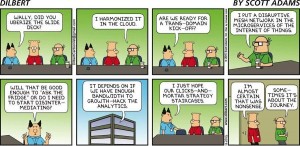
A Friday series exploring Startups and the people who make them go. Read all If the Shoe Fits posts here.
Have you ever wondered where all the bullshit business terms (BBT) came/come from, especially since their spread predates the Net and social media by decades?
A fascinating article in the Guardian traces the birth and rise of business bullshit that sprang from a 20th-century Russian mystic, was embraced by corporate leaders, inspired Scott Adams of Dilbert fame, and has been re-imagined and added to by consultants and pundits ever since.
It hasn’t always been this way. A certain amount of empty talk is unavoidable when humans gather together in large groups, but the kind of bullshit through which we all have to wade every day is a remarkably recent creation.
Founders and others in tech are especially fond of BBT as they go about changing the world.
There’s even an online generator that takes the effort out of remembering terms yourself.
Business bullshit always reminds me of a guy I worked with, who believed the more multi-syllabic words he used the smarter he would sound.
He didn’t and you won’t either.
The article is long, but well worth the reading time.
It might even help squelch your own penchant for using them.
Hat tip to CB Insights for pointing me to the article.
Image credit: Scott Adams
Posted in Communication, If the Shoe Fits, Personal Growth | No Comments »
Wednesday, August 30th, 2017
 Note: It’s imperative to recognize that culture has nothing to do with perks, such as free food, fancy offices, free services, etc. Note: It’s imperative to recognize that culture has nothing to do with perks, such as free food, fancy offices, free services, etc.
Culture is about values and how they play out in both the internal and external functioning of the company.
But company culture isn’t the end game — micro cultures are.
Micro cultures are based on individual bosses’ values.
Both cultures are fundamental to that perennially popular subject, employee engagement.
HBS’ Jim Heskett recently asked his audience what’s needed to engender employee engagement given that engaged employees are 2.7% more productive.
Most of the responses talked about the need for managers to respect their people, listen to ideas from everyone, have better people skills, etc., and several mentioned the skills acquired with an MBA.
But, as I pointed out, and Heskett cited in his summary, “Respect and valuing employee input have little to do with education and much to do with personal values.”
Unfortunately, education is no guarantee of values.
Colleges are no different, with MBA students leading the pack. “56 percent of MBA students admitted to cheating… In 1997, McCabe did a survey in which 84 percent of undergraduate business students admitted cheating versus 72 percent of engineering students and 66 percent of all students. In a 1964 survey by Columbia University, 66 percent of business students surveyed at 99 campuses said they cheated at least once.”
If scholastic success was based on cheating it’s likely that that lack of respect/get-ahead-at-all-costs mentality would carry over to their management style.
Yesterday’s post ended with this comment,
That [provide an environment in which people can learn, grow and excel] is what a good boss is supposed to do.
But it’s the great ones who actually do it.
In fact, they go beyond that and shelter their people from any kind of toxic culture coming down from above.
Image credit: thinkpublic
Posted in Culture, Ethics | No Comments »
Tuesday, January 5th, 2016
KG sent this to me and I had to share it, in spite of the cease and desist letter I may get from the lawyers.

And for great information on how to avoid being a pointy-haired boss check out the January Leadership Development Carnival.
Image credit: Scott Adams
Posted in Communication, Culture, Ducks In A Row, Personal Growth | No Comments »
Tuesday, December 15th, 2015

There’s a lot of talk out there about the best ways to engage your people, with the dual goals of juicing creativity and innovation and hiking productivity.
As founder and CEO of Quarrio, I spend a lot of energy and time building and sustaining a culture that fosters an environment in which our people flourish.
I believe that is what produces the desired engagement results.
That is why we don’t give a damn about gender, age or alma mater; even skills and experience take a backseat to attitude when we hire.
My whole team, not just senior staff, talk about this frequently.
Recently one them shared this internet meme as a mathematical view of what we all believe.
And since it’s the time for gifts and sharing, I thought I would share it as my holiday gift to you.
This comes from 2 math teachers with a combined total of 70 yrs. experience.
What Makes 100% ?
What does it mean to give MORE than 100%?
Ever wonder about those people who say they are giving more than 100%? We have
all been to those meetings where someone wants you to give over 100%.
How about achieving 103%?
What makes up 100% in life?
Here’s a little mathematical formula that might help you answer these questions:
If:
A B C D E F G H I J K L M N O P Q R S T U V W X Y Z
Is represented as:
1 2 3 4 5 6 7 8 9 10 11 12 13 14 15 16 17 18 19 20 21 22 23 24 25 26.
Then:
H-A-R-D-W-O-R-K
8+1+18+4+23+15+18+11 = 98%
And
K-N-O-W-L-E-D-G-E
11+14+15+23+12+5+4+7+5 = 96%
But,
A-T-T-I-T-U-D-E
1+20+20+9+20+21+4+5 = 100%
And,
B-U-L-L-S-H-I-T
2+21+12+12+19+8+9+20 = 103%
And look how far ass kissing will take you.
A-S-S-K-I-S-S-I-N-G
1+19+19+11+9+19+19+9+14+7 = 118%
So, one can conclude with mathematical certainty, that while Hard Work and
Knowledge will get you close, and Attitude will get you there.
It’s the Bullshit and Ass Kissing that will put you over the top.
Now you know why some people are where they are!
I wish you a wonderful holiday season filled 100% with joy, family, friends, colleagues and great food.
Posted in Communication, Culture, Personal Growth | No Comments »
Tuesday, October 6th, 2015

I hear a lot form bosses who want to build good culture, but are frustrated because of an excess of how-to information — much of it contradictory.
By popular request here are the only two things you need to know to build an effective culture — everything else flows from them.
First, you have to believe the basic premise.
- People are intelligent, motivated and want to help their company/boss succeed.
Second, you need to back that belief up with appropriate action.
- Provide your people with all the information needed to understand how to perform their work as correctly, completely and efficiently as possible.
Culture frames workplace relationships and, like any relationship, it’s about open communications.
Sharing information is a sign of trust and encourages people to become more involved.
When people know about their job/company/industry and how they all interact, they will perform their own duties better and more productively — because they understand what’s going on they are encouraged to take more ownership and care.
Valuing people and open communications are the bedrock of a great culture and a boss people want to work for.
Bottom line, what to do is simple.
Doing it takes discipline.
Flickr image credit: Mike M
Posted in Communication, Culture, Ducks In A Row | 1 Comment »
Friday, April 3rd, 2015
A Friday series exploring Startups and the people who make them go. Read all If the Shoe Fits posts here
 Founder: I can’t be a good leader without knowing my people. How I can contribute to their life? Founder: I can’t be a good leader without knowing my people. How I can contribute to their life?
Me: You are going to have a lot of people who have no interest in sharing their personal life with you or having you contribute to it other than providing a great place to work.
Founder: How? I am a leader who prefers 1 on 1
Me: It’s not about you, it’s about them and what interaction they prefer; and as the company grows you will not have time or access for 1/1, unless you plan to interfere with your managers’ organizations. What it is about is the culture you create.
Founder: You can’t lead if you can’t connect.
Me: Connection is not always 1/1; that’s why culture is so important.
Founder: You have to know your people.
Me: No, you need to know your direct reports and know that they are supporting your culture. Anyway, good leadership should be spread around your company and not just the province of certain positions.
Founder: You can’t convince me. I have had coffee with my subordinates to know them and that catapulted us. Culture is about having a tea, cappuccino with my subordinates and talking about stuff, then car-pooling.
Me: I’m not saying to stop, I’m saying it won’t work with everyone, plus, you won’t have time as the company grows. There are many people who have no interest in that kind of intimate, personal relationship with their boss, but are world-class hires. They care about the company’s culture because they know it reflects the founder’s values.
Me: Moreover, bosses who can only relate 1/1 are often seen as playing favorites, because they tend to favor those who respond to their approach.
Me: If you try to cram every hire into any one, narrow MAP it will cost you talent and engagement, because those who don’t like it will either walk or disengage.
Me: The important takeaway here is that when it comes to worker interaction one size does not fit all.
Image credit: HikingArtist
Posted in Hiring, If the Shoe Fits, Personal Growth | 1 Comment »
|
 Subscribe to
MAPping Company Success
About Miki 
Clarify your exec summary, website, etc.
Have a quick question or just want to chat? Feel free to write or call me at 360.335.8054
The 12 Ingredients of a Fillable Req
CheatSheet for InterviewERS
CheatSheet for InterviewEEs™
Give your mind a rest. Here are 4 quick ways to get rid of kinks, break a logjam or juice your creativity!
Creative mousing
Bubblewrap!
Animal innovation
Brain teaser
The latest disaster is here at home; donate to the East Coast recovery efforts now!
Text REDCROSS to 90999 to make a $10 donation or call 00.733.2767. $10 really really does make a difference and you'll never miss it.
And always donate what you can whenever you can
The following accept cash and in-kind donations: Doctors Without Borders, UNICEF, Red Cross, World Food Program, Save the Children
*/
?>About Miki
About KG
Clarify your exec summary, website, marketing collateral, etc.
Have a question or just want to chat @ no cost? Feel free to write
Download useful assistance now.
Entrepreneurs face difficulties that are hard for most people to imagine, let alone understand. You can find anonymous help and connections that do understand at 7 cups of tea.
Crises never end.
$10 really does make a difference and you’ll never miss it,
while $10 a month has exponential power.
Always donate what you can whenever you can.
The following accept cash and in-kind donations:
|