|
|
|
Monday, January 29th, 2018
Poking through 11+ years of posts I find information that’s as useful now as when it was written.
Golden Oldies is a collection of the most relevant and timeless posts during that time.
The Peter Principle was published in 1969, but the principle was just as true in 3000 BC as it is in 2018 and all the time in-between. It’s a lucky team that has a boss wise enough to keep the principle firmly in mind.
Read other Golden Oldies here.
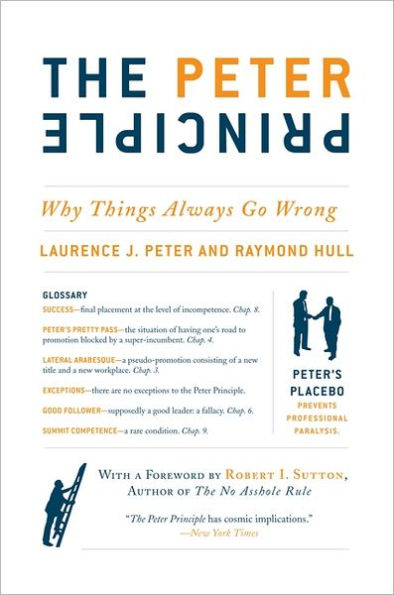
Bob Sutton, author of The No Asshole Rule, recently wrote a 40th anniversary tribute called The Peter Principle Lives.
For those of you too young to remember, the Peter Principle states that “In a hierarchy, every employee tends to rise to his level of incompetence.”
“Dr. Peter argued, “When people do their jobs well, society can’t leave well enough alone. We ask for more and more until we ask too much. Then these individuals—promoted to positions in which they are doomed to fail—start using a bag of tricks to mask their incompetence. They distract us from their crummy work with giant desks, replace action with incomprehensible acronyms, blame others for failure, cheat to create the illusion of progress.”
Well put and oh, so, ironic.
The very supermen who performed such extraordinary feats of financial legerdemain were actually at the peak of their Peter Principle.
Sutton writes, “If Dr. Peter were alive today, he’d find that a new lust for superhuman accomplishments has helped create an almost unprecedented level of incompetence. The message has been this: Perform extraordinary feats, or consider yourself a loser.”
What do you ask of your people?
Do you ask for competency; for them to do the best they are capable of at that point in time? Do you give them the tools, training, support and opportunities to grow and develop?
Or do you promote your people before any of these happen, tossing them into the deep end of the pool to swim—or drown.
As a manager at any level you hold your people’s future in your hands. At any point you have the choice of helping them on their path to success, slowing them down or destroying them.
What do you choose?
Image credit: Barnes and Noble
Posted in Communication, Culture, Golden Oldies, Personal Growth | No Comments »
Monday, January 8th, 2018
It still surprises me, but poking through 11+ years of posts I find information that’s as useful now as when it was written.
Golden Oldies is a collection of the most relevant and timeless posts during that time.
“Joe” called to wish me a happy 2018 and update me on what he’s doing. It’s been six years since decided to ignore the pressure pushing him to become an entrepreneur.
Since then he’s changed companies twice and was just promoted to director of advanced engineering. He’s having a great time building a team to work on a totally new product. Joe says he’s having a ball.
Joe is proof of two things
- Peer pressure never ends.
- Winners do what they want, not what other people think they should want.
Read other Golden Oldies here.
 “Joe” called me today. He said he was thinking of leaving his company not because he wanted to, but because everyone thought he should. “Joe” called me today. He said he was thinking of leaving his company not because he wanted to, but because everyone thought he should.
He explained that everyone who knew him kept showing him articles and telling him that he was a born entrepreneur and should start his own company.
Joe said he had worked for everything from large companies to startups and as long as he had a good manager and liked the culture he was happy. He worked hard and felt he was fairly compensated.
Joe said he had discussed it with his family and they said he should do what made him happy and they would support that decision.
However, he didn’t want to end up looking like a loser because he didn’t do it.
Boiled down, here is my response.
- Contrary to current media coverage people who work for companies are not losers and entrepreneurs are not the be all and end all of success.
- Few, if any, knowledge workers at any level work 8-hour days, disconnect and go home.
- In the current recession, entrepreneurs are to the 21st Century what consultants were to the recessions of the 20th Century.
- Having entrepreneurial MAP does not mean you want, or have to be, an entrepreneur.
The last point is especially important.
I saw yet another list of 10 traits of entrepreneurs and I had to chuckle. Here it is
- They Are Not Stopped by Fear
- They Know When to Ask for Help
- They Are Persistent
- They Are Passionate About Their Businesses
- They Are Willing to Market and Sell
- They Know Their Numbers
- They’re Disciplined
- They Have Integrity
- They’re Great Communicators
- They Think Long-Term
I chuckled because these are the same traits that all good people have when adjusted for their position and experience.
They are also the traits that the best managers look for when they are hiring. There are, however, many mangers too insecure to appreciate them.
Many years ago I read an article about the guy who invented the tiles used on the Challenger spacecraft to protect it when it reentered the atmosphere.
He wasn’t an entrepreneur, he was a Lockheed engineer. He didn’t get a bonus for his work, it was his job. He didn’t care; he was happy at his company, proud of what he did and liked being part of something larger.
He was a winner.
The lesson here is that great people work for existing companies and great people start companies and both win.
Joe is a winner.
The losers are those who disparage other people’s choice.
Image credit: chokingsun
Posted in Golden Oldies, Motivation, Personal Growth | No Comments »
Thursday, December 28th, 2017
 The holidays are fully upon us and we are immersed in responsibilities to friends and family, at least I am. My family is spread all throughout the country and, as a result, it can be quite an orchestration to have more than a few people in the same geography. The holidays are fully upon us and we are immersed in responsibilities to friends and family, at least I am. My family is spread all throughout the country and, as a result, it can be quite an orchestration to have more than a few people in the same geography.
I tend to be a people-pleaser as well, so, if there are multiple parties involved, I find myself pulled in various directions, all to keep them happy. I will tell you that this is not fun and does not benefit anyone.
The capstone holiday, of course, is New Years. It is a chance to renew and rebirth yourself into the desired image you have set forth.
My desired image would include not worrying as much about keeping people happy and more focus on my long-term goals.
Which brings us to the question, why wait? Why wait ’till that magical stroke of midnight to enable us to be our best selves?
In one regard it can be easier to wait until the tide of society is on board with us when making good decisions. I made a decision some time ago to no longer drink alcohol; I realized I could be a better version of myself by cutting it out. I will tell you that it can be a lonely walk when you are the only one making a decision like that. It wasn’t a New Year’s choice, but done during an off time of year. As a result, I really didn’t have anyone to share in the decision.
So perhaps that’s it?
Do we like the positive peer pressure of making informed choices together? It is a lot more fun going to the gym when out of shape if other folks in the same boat are there. It can also be fun to indulge in that extra piece of chocolate during the holidays’ guilt-free in the knowledge that next week you will be your best self.
How do we apply this to work?
Do you sit at your desk on a Friday and think, “I’ll get to that next week?” I know I do and it can be destructive if left unchecked. Or perhaps you are the type of person who embraces all tasks with gusto and will work to solve that problem regardless of time.
First off, I want whatever you have, and secondly, how do you sustain it?
Either approach has its benefits and risks, but which can lead to our best self.
What is your best self?
Flickr image credit: BK
Posted in Personal Growth, Ryan's Journal | No Comments »
Thursday, October 5th, 2017
This week’s events have been shocking and heartbreaking for many. As I currently write this post, 58 people have been killed in the Vegas shootings and over 500 others have been injured.
An event that was meant to be an evening of fun turned into a nightmare. I cannot begin to fathom the pain people are going through and my heart is with them.
These posts will never become overtly political and I am not well versed enough in policy debates to chime in. One thing I do understand though is the value of life.
As a father I cherish my girls and wife. As a former Marine I have experienced immense loss as comrades have fallen in combat. I have seen the best and worst of humanity and at times struggle to understand it.
In this case we have had a tragic event that seems to have no apparent reason as of yet. As business people and fellow humans how can we respond?
It can be cliché to say we should treat every moment as our last, but there is some truth to that. In addition though we can look at ways to add value to people’s lives daily.
In sales we are taught to always generate value. Understand a client’s problem and seek to find a solution.
Just today I spoke with someone who is evaluating a complex software solution. After speaking for a bit it became apparent that he needed more information, so I sent him a relevant white paper and followed up to ensure it helped on his quest.
There are also times where we can generate massive value in a short period of time.
One survivor of the Vegas shootings found a truck with the keys still in it. He decided to take it and made three trips to the hospital delivering roughly 30 people who needed care. This person adapted to the situation, identified a need, and acted.
Tomorrow when you’re at work what will you identify as a need?
We always have a choice to lament the problem and not act.
Or we can choose to take massive action.
I choose action.
Image credit: Olga Berrios
Posted in Personal Growth, Ryan's Journal | No Comments »
Thursday, August 10th, 2017

Have you ever had one of those days where you just can’t seem to get it together?
You drink your coffee, go on your run, or perhaps your moment of zen. Yet that doesn’t get you out of your rut. What do you do about it?
I am in a stage of life where I am building.
I am building my sales practice, building my family (up to five now), and building my wealth. I have found that those all keep me busy and I have little time for me. When I compare myself to my friends, though, they are in similar circumstances.
The ebb and flow of emotions is normal. Low points happen and should not be feared. However, if we allow ourselves to dwell too long, it can become more than a rut, it can be a lifestyle.
I have a new little girl at home and she is amazing. She also is a night owl and I have found that sleep deprivation and feeling down are directly correlated. My wife and I are walking around in a fog and I am not at my best.
I have started to become aware of this in the past week and have actively worked out ways to overcome it.
Currently my little one likes to wake around 5:30 in the morning. I have found if I just get up to go for a run I get the added bonus of watching the sun rise. That’s an amazing feeling.
I have also found that she likes to cry a bit so we stay up rocking her. This has led to my wife and I having genuine conversations because our phones aren’t attached to our faces. This has also been amazing as I actually like my wife. (To be clear I love her as well).
I say all of this because it’s on my mind. I know I am a bit low and I know others are too on occasion.
Ultimately it is our choice on how we proceed.
How will you proceed?
Image credit: Larry Jacobsen
Posted in Personal Growth, Ryan's Journal | No Comments »
Monday, May 22nd, 2017
It’s amazing to me, but looking back over more than a decade of writing I find posts that still impress, with information that is as useful now as when it was written.
Golden Oldies is a collection of some of the best posts during that time.
I always find it strange that a post this old (2006) doesn’t need updating to be relevant — but it doesn’t. Nothing has changed. You are still the closest thing to a silver bullet that you’re going to find and it’s still all in your mind.
Read other Golden Oldies here.
 These days (especially these days) managers spend time, energy and money (their company’s and their own) in an effort to move from manager to ‘leader’. They study examples and best practices, read books, attend seminars and classes, take advanced degrees, check out software, turn to the spiritual (if so inclined)—you name it, someone’s tried it. These days (especially these days) managers spend time, energy and money (their company’s and their own) in an effort to move from manager to ‘leader’. They study examples and best practices, read books, attend seminars and classes, take advanced degrees, check out software, turn to the spiritual (if so inclined)—you name it, someone’s tried it.
Everywhere you turn you hear/read about how you need to be a ‘leader’ to get ahead, otherwise you’ll end up a <gasp> follower.
You probably won’t believe me if I say that the basic premise is bunk.
The dream is to find a silver bullet—all you need to do is say/do THIS—but it ain’t gonna happen.
But here’s the well kept secret—you already possess the closest thing to a silver bullet that exists and it’s all in your mind.
That’s right, it’s your MAP and, like a snowflake, it’s totally unique—yours, and yours alone.
And the magic that turns the bullet from lead to silver is your ability to consciously choose to change your MAP through your own awareness.
How cool is that? The very thing that frees you to soar and it’s not only yours, but also within your control.
Who could ask for anything more?
So never forget!
You are the silver bullet!
Image credit: ijm2007
Posted in Golden Oldies, Personal Growth | No Comments »
Monday, January 9th, 2017
It’s amazing to me, but looking back over more than a decade of writing I find posts that still impress, with information that is as useful now as when it was written.
Golden Oldies is a collection of what I consider some of the best posts during that time.
You hear a lot about “context” these days; mostly people claiming that their comments were taken “out of context” or some variation of that. People are very aware of context, but seem to forget about “perception.” Context, in or out of, doesn’t really matter; what matters is the perception, whether your own or others. The recent campaign, no matter what side you were on, is a good example of how perception trumps everything.
Read other Golden Oldies here.
There is an ongoing debate in academic, and other, circles as to whether or not humans have free will.
Reading the latest arguments made for an interesting break, but my final reaction was, “Who cares.” However, the manager with whom I was discussing it was thoroughly upset and demanded to know how I could think that. He said that if he had no free will then all his efforts to improve had no value, since the results were predetermined, it didn’t matter what he did. (Hey, we all have bad days.)
When I explained why I thought his reaction was way out in left field, he said I should blog the answer, that it would do other’s a lot of good, so I did.
Primarily, I don’t care because I’ve found that everything is a matter of perception, and that for every person who proclaims TRUTH (in capitals), there is a counter perception held just as vehemently by someone else.
When people seek to improve/change skills, attitudes or whatever, they do so because they perceive a benefit in doing so, whether there actually is one of not is beside the point.
Fortunately, or not, no matter what the perception, one can find like-minded people who share it—the Earth is round, but not to everybody.
Life lasts a certain amount of time and all lives have highs and lows, but it’s the perception of the individual that determines which is which.
In other words, the choice is yours.
Posted in Communication, Golden Oldies, Personal Growth | No Comments »
Monday, March 28th, 2016
It’s amazing to me, but looking back over a decade of writing I find posts that still impress, with information that is as useful now as when it was written. Golden Oldies is a collection of what I consider some of the best posts during that time.
Do you spend any time reading archives from sources you like? I don’t mean stuff that’s a few months old or even a couple of years. I mean thought pieces dating back 5, 10, 15 years ago or even more, especially those focused on what bosses need to do to motivate, retain and get the best from their teams. The problem is not in the content, nor how pertinent it is. The problem is that it’s still applicable, which means bosses haven’t changed much, if at all over all that time — but the workforce has. Here’s an example of what I mean. Read other Golden Oldies here.
My post yesterday brought an interesting question from Dan L. in Boston. He said, “Why in the world would any manager do anything that would reduce the options available to identify a solution needed in his/her group, especially a CEO?”
So, I paraphrased five reasons that I’ve actually heard, in one form or another, from top managers who talked about being out of the box, but really wanted to stay in it.
- Think outside—as long as it doesn’t make me uncomfortable.
- Don’t challenge the status quo in a manner that scares me.
- Be creative within parameters I can understand.
- If you want to breach the box, do it my way.
- We’ve never done it that way.
At first, Dan was incredulous, then he really thought about what’s behind each of the five reasons, and he understood what anybody who really listens to the thoughts behind people’s words comes to know.
Out of the box is about change, and change is scary—for everybody.
But it’s not about being scared, it’s about how you choose to handle it.
That’s right, choose.
Your responses, your choice.
Think about it this weekend.
Then, when you get to the office Monday and one of your people has a great idea that scares the dickens out of you, consciously choose how you respond—knowing that no matter how you choose the ripples of that choice will spread and impact not only your future, but also the future of your people and your company.
Posted in Golden Oldies, Motivation, Personal Growth | No Comments »
Friday, January 8th, 2016
A Friday series exploring Startups and the people who make them go. Read all If the Shoe Fits posts here
 On one of the last days of 2015 I read a great article about the groupthink that pervades Silicon Valley these days. On one of the last days of 2015 I read a great article about the groupthink that pervades Silicon Valley these days.
It reminded me of how teens of every generation display their rebellion against society through their choice of clothes, while simultaneously making sure they “fit in” with their peers.
This is most easily seen in a subgroup like the goths, whose black clothing and makeup sets them apart from other teens, but within which a rigid dress code prevails.
Unlike the Silicon Valley I knew in the 1980s and 90s, today’s Silicon Valley is far more homogenized and undiversified, with little perspective on the “real” world.
The result is that it’s far less creative and exciting than it once was.
Silicon Valley groupthink is also the force behind what Danielle Morrill, CEO & Cofounder of Mattermark, calls the “tyranny of should.”
But sometimes when I am able to quiet that story down, I catch myself listening because it is just so much easier to have someone else figure out what I should do.
In the first days of this new year I urge you to choose between taking the easy road of groupthink and should or following Sam Altman’s path of most resistance.
“You should ignore what your peers are doing or what your peers or parents think is cool. (…) And that’s the hardest part. We’re all so much more susceptible to that than we think.”
Yes, another ‘should’, but not all ‘shoulds’ are created equal.
As always, it’s your choice.
That’s both life’s greatest joy and its greatest fear.
Image credit: HikingArtist
Posted in If the Shoe Fits | No Comments »
Monday, November 23rd, 2015

It’s amazing to me, but looking back over nearly a decade of writing I find posts that still impress, with information that is as useful now as when it was written. Golden Oldies is a collection of what I consider some of the best posts during that time. Read other Golden Oldies here
The Tao of Life
We learn through words and can often learn more by deconstructing them.
Just as one of the most critical managerial (human) actions is found in its own anagram the Tao of another is found within the word itself.
The word is LIFE.
The Tao of life is IF.
IF you think/say/do this instead of that the Tao changes.
The IF isn’t always conscious or obvious.
But it is there.
It’s up to you to choose consciously.
Flickr image credit: gfpeck
Posted in Golden Oldies, Personal Growth | No Comments »
|
 Subscribe to
MAPping Company Success
About Miki 
Clarify your exec summary, website, etc.
Have a quick question or just want to chat? Feel free to write or call me at 360.335.8054
The 12 Ingredients of a Fillable Req
CheatSheet for InterviewERS
CheatSheet for InterviewEEs™
Give your mind a rest. Here are 4 quick ways to get rid of kinks, break a logjam or juice your creativity!
Creative mousing
Bubblewrap!
Animal innovation
Brain teaser
The latest disaster is here at home; donate to the East Coast recovery efforts now!
Text REDCROSS to 90999 to make a $10 donation or call 00.733.2767. $10 really really does make a difference and you'll never miss it.
And always donate what you can whenever you can
The following accept cash and in-kind donations: Doctors Without Borders, UNICEF, Red Cross, World Food Program, Save the Children
*/
?>About Miki
About KG
Clarify your exec summary, website, marketing collateral, etc.
Have a question or just want to chat @ no cost? Feel free to write
Download useful assistance now.
Entrepreneurs face difficulties that are hard for most people to imagine, let alone understand. You can find anonymous help and connections that do understand at 7 cups of tea.
Crises never end.
$10 really does make a difference and you’ll never miss it,
while $10 a month has exponential power.
Always donate what you can whenever you can.
The following accept cash and in-kind donations:
|