|
|
|
Wednesday, August 29th, 2018

What do the companies with the best customer service have in common?
Engaged employees.
Engaging workers isn’t dependent on salary and perks, if it was, Chick-fil-A, Trader Joes and Aldi (TJ’s parent company) wouldn’t hold the top three spaces on the Forbes Best Customer Service List.
While there are many things that can drive engagement, good management is probably at the top of the list.
And while the executive team impacts engagement, it’s the individual’s own manager who really makes the difference.
A bad manager will taint the best corporate culture, while a really good one will offset bad culture by acting sheltering their team from the impact.
Back in 2008 I listed four points needed to engage your team, and they are just as true, if not more so, a decade later.
- The guideline is the same thread that has run through every major philosophy and religion for thousands of years—treat your people as you want to be treated, whether your boss treats you that way or not.
- Authenticity is the current buzz word, but it translates simply to be honest, open and do what you say; never fudge, let alone lie, intentionally or otherwise.
- There are absolutely no circumstances that warrant or excuse the messenger being killed. None. Because if you do, there’s no going back—ever.
- If your company doesn’t have an engaging culture then you must be an umbrella for your people, because you can create one below you, even if you can’t change it above.
Truly great customer service requires engaged employees, because they are the only ones who can provide customers with the best experience possible.
Image credit: mikeg44311
Posted in Culture, Motivation, Retention | No Comments »
Monday, June 25th, 2018

Poking through 11+ years of posts I find information that’s as useful now as when it was written.
Golden Oldies is a collection of the most relevant and timeless posts during that time.
If you read me often you’ll know I love words. I love them not only because of how they can be used to tell a story, but also because the answers to complex questions are often found within a single word — in the form of an anagram.
Here is one of my favorites.
And join me tomorrow for a six word anagram that comprises some of the best and most timeless management advice you’ll ever learn.
Read other Golden Oldies here.
The Tao of Life
We learn through words and can often learn more by deconstructing them.
Just as one of the most critical managerial (human) actions is found in its own anagram the Tao of another is found within the word itself.
The word is LIFE.
The Tao of life is IF.
IF you think/say/do this instead of that the Tao changes.
The IF isn’t always conscious or obvious.
But it is there.
It’s up to you to choose consciously.
And wisely.
Image credit: gfpeck
Posted in Golden Oldies, Personal Growth | No Comments »
Wednesday, June 13th, 2018
The last two posts reminded me of something KG sent (also used here).
It neatly sums up the state of our nation these days.
Actually, it probably sums up the state of every nation on Earth.
That said, it has nothing to do with politics or who is on which side.
You can find every kind of MAP, from far left to far right to none of the above, represented in each of the three categories mentioned.
 The pigs go back to the dawn of humanity. The pigs go back to the dawn of humanity.
The wolves, too, although their tools today reach farther and are more predatory than ever before.
Sadly, the sheep are multiplying and becoming ever more sheeplike .
Image credit: Internet meme
Posted in Ethics, Personal Growth | No Comments »
Monday, May 7th, 2018
Poking through 11+ years of posts I find information that’s as useful now as when it was written.
Golden Oldies is a collection of the most relevant and timeless posts during that time.
When I wrote this a decade ago it resulted in a comment and my response, which are included today. The reason I included my response is because, in these days of bad examples, lower self-control and less personal responsibility the responsibility of leaders is even greater. As you will see in tomorrow’s post.
Read other Golden Oldies here.
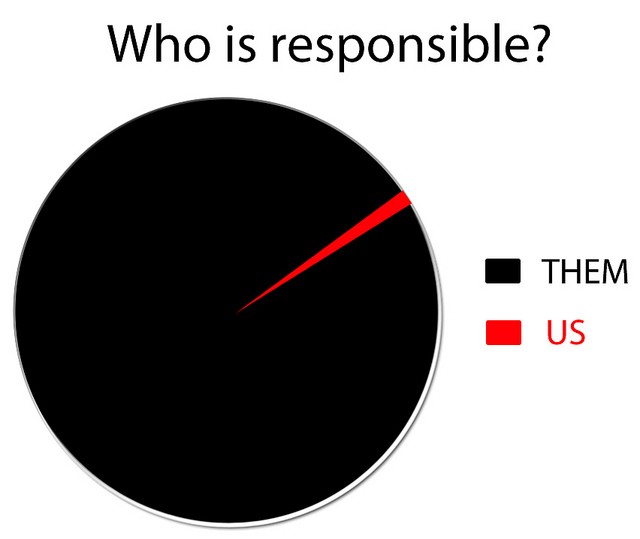
What responsibility?
A lot.
My focus isn’t meant to be just race or gender issues, but on the attitude that I’m/we’re-right-so-you-should-do/think-our-way-or-else. It’s not the ‘we’re right/you’re wrong’ that bothers me, but the ‘do-it-our-way-or-else’ that shows the intolerance for what it really is.
During my adult life (I missed being a Boomer by a hair) I’ve watched as hate and intolerance spread across the country masked by religion, a façade of political correctness or a mea culpa that is supposed to make everything OK, but doesn’t.
Various business, political, religious and community leaders give passionate, fiery talks to their followers and then express surprise and dismay when some of those same followers steal trade secrets, plant bombs, and kill individuals—whose only error was following their own beliefs.
No longer are we all entitled to the pursuit of happiness if our happiness offends someone next door or living at the other end of the country.
I remember Ann Rand saying in an interview that she believed that she had the right to be totally selfish, where upon the interviewer said that would give her freedom to kill. Rand said absolutely not, in fact the reverse was true, since her selfishness couldn’t take away anyone else’s right to be selfish. That about sums up my attitude
I just wish there were fewer followers for all the Ellsworth Toohey types in today’s world.
- Kathy Says:
I don’t know if you can blame abstract entities such as leadership business or religion or politics for the actions of individuals. I’m tempted to put the blame on the person taking the action. There is a big difference between hearing someone talk and acting on the content of the talk. We hear people talk persuasively all the time about the importance of saving for retirement or flossing our teeth or using sunscreen, and many, many people who’ve heard these persuasive speeches do none of the above. So, I’d say, no matter what people are saying to me, in the newspaper, on TV or over coffee, if I take the action, I’m responsible for the result. I always had the choice.
- Miki Saxon Says:
Kathy, I agree that it is the responsibility of followers to think, but we live in an age where many people have opted out of thinking, and merely follow the lead of any person with whom they are comfortable (see the 9 post on followers) For that reason I do hold the leaders, who aren’t abstract, and incite their followers through passionate rhetoric responsible for the outcome. I think they are responsible for the results of their comments.
Image credit: Sean MacEntee
Posted in Golden Oldies, Leadership, Personal Growth | No Comments »
Monday, April 2nd, 2018

Poking through 11+ years of posts I find information that’s as useful now as when it was written.
Golden Oldies is a collection of the most relevant and timeless posts during that time.
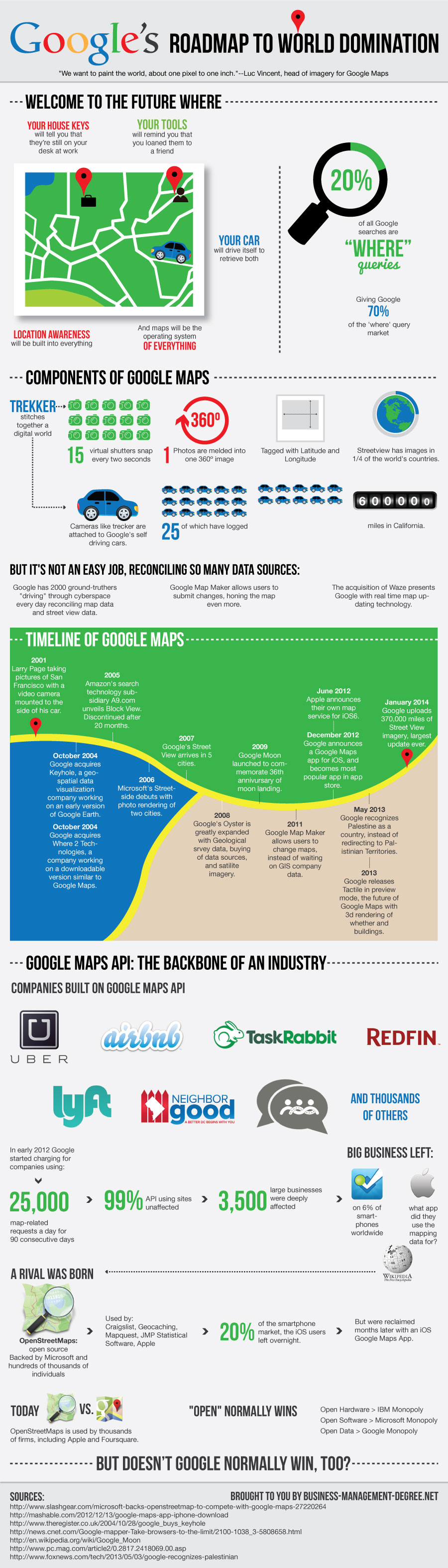
A year after I wrote this Alphabet was created as the holding company for Google and its siblings and “Don’t be evil” was scrapped in favor for “Do the right thing.” Supposedly nothing changed, but it did open the door to a wider definition. In the years since, doing the right thing for stockholders seemed focused on maximizing their returns in every way possible. This included mining personal data, with or without permission, and selling it to advertisers.
Until now, money seems to have acted much like Holy water, eliminating the taint of evil from the acts of Google and its ilk. Europe has been fighting, passing laws and working to hold these companies responsible. Now, Americans are waking up to just how much damage Google, Facebook, etc., have done/are doing and saying ‘enough is enough’.
Read other Golden Oldies here.
Did you know that the sixth point of Google’s 10-point corporate philosophy is “You can make money without doing evil?”
But ‘evil’ is a fluid term when it comes to making money.
And if Google is into anything it is into making money.
Take Google Plus. Google isn’t trying to displace Facebook and doesn’t even care if you use it.
That’s not really the point.
Google Plus may not be much of a competitor to Facebook as a social network, but it is central to Google’s future — a lens that allows the company to peer more broadly into people’s digital life, and to gather an ever-richer trove of the personal information that advertisers covet.
Plus is now so important to Google that the company requires people to sign up to use some Google services, like commenting on YouTube.
Some people have no problem being tracked and their personal information being shared to the enrichment of the sharing parties.
To millions of others, stalking in the name of better ad targeting smacks of evil.
Of course, when world domination is your long-term goal you need to keep those definitions fluid.
Posted in Culture, Golden Oldies | No Comments »
Thursday, February 8th, 2018
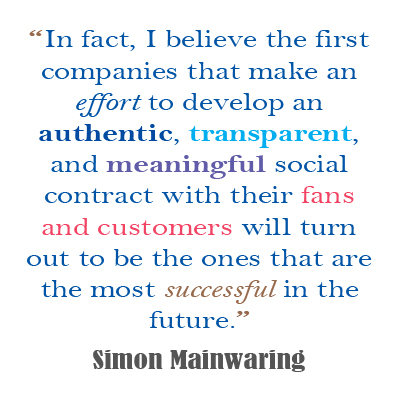
I have been traveling this week visiting clients to advance a few opportunities I am working on. One thing that came up throughout the meetings was the need for authenticity.
It seems to be the result of too many salespeople doing a quick transaction and leaving the customer high and dry after. I was struck by their need. Not so much because I haven’t heard it, but that it is coming up in almost all of my conversations.
As a salesperson, I am always looking for ways to provide value to a client and become their trusted advisor. I’ll be honest, it doesn’t happen overnight, but with some effort and true insight it can be achieved.
We as humans have a responsibility to others to put forth our best, be trustworthy and learn to work together as a team. It was my client, however, who showed me that partnership is what matters most.
It made me think about how does one achieve that partnership?
A lot of it is listening and having the business acumen that can fully understand and address complex issues. Some of it is time spent with someone. Some of it is personality.
Being an authentic human being goes a long way in my book and always putting others needs ahead of your own. Being humble and appreciative will pay off huge dividends.
Beyond sales, how else can we be authentic?
Perhaps it’s taking ownership over a project. Asking for mentorship. Seeking out new people to learn from. Etc.
What do you do to build partnerships and become authentic?
Image credit: Barbara
Posted in Personal Growth, Ryan's Journal | No Comments »
Monday, January 8th, 2018
It still surprises me, but poking through 11+ years of posts I find information that’s as useful now as when it was written.
Golden Oldies is a collection of the most relevant and timeless posts during that time.
“Joe” called to wish me a happy 2018 and update me on what he’s doing. It’s been six years since decided to ignore the pressure pushing him to become an entrepreneur.
Since then he’s changed companies twice and was just promoted to director of advanced engineering. He’s having a great time building a team to work on a totally new product. Joe says he’s having a ball.
Joe is proof of two things
- Peer pressure never ends.
- Winners do what they want, not what other people think they should want.
Read other Golden Oldies here.
 “Joe” called me today. He said he was thinking of leaving his company not because he wanted to, but because everyone thought he should. “Joe” called me today. He said he was thinking of leaving his company not because he wanted to, but because everyone thought he should.
He explained that everyone who knew him kept showing him articles and telling him that he was a born entrepreneur and should start his own company.
Joe said he had worked for everything from large companies to startups and as long as he had a good manager and liked the culture he was happy. He worked hard and felt he was fairly compensated.
Joe said he had discussed it with his family and they said he should do what made him happy and they would support that decision.
However, he didn’t want to end up looking like a loser because he didn’t do it.
Boiled down, here is my response.
- Contrary to current media coverage people who work for companies are not losers and entrepreneurs are not the be all and end all of success.
- Few, if any, knowledge workers at any level work 8-hour days, disconnect and go home.
- In the current recession, entrepreneurs are to the 21st Century what consultants were to the recessions of the 20th Century.
- Having entrepreneurial MAP does not mean you want, or have to be, an entrepreneur.
The last point is especially important.
I saw yet another list of 10 traits of entrepreneurs and I had to chuckle. Here it is
- They Are Not Stopped by Fear
- They Know When to Ask for Help
- They Are Persistent
- They Are Passionate About Their Businesses
- They Are Willing to Market and Sell
- They Know Their Numbers
- They’re Disciplined
- They Have Integrity
- They’re Great Communicators
- They Think Long-Term
I chuckled because these are the same traits that all good people have when adjusted for their position and experience.
They are also the traits that the best managers look for when they are hiring. There are, however, many mangers too insecure to appreciate them.
Many years ago I read an article about the guy who invented the tiles used on the Challenger spacecraft to protect it when it reentered the atmosphere.
He wasn’t an entrepreneur, he was a Lockheed engineer. He didn’t get a bonus for his work, it was his job. He didn’t care; he was happy at his company, proud of what he did and liked being part of something larger.
He was a winner.
The lesson here is that great people work for existing companies and great people start companies and both win.
Joe is a winner.
The losers are those who disparage other people’s choice.
Image credit: chokingsun
Posted in Golden Oldies, Motivation, Personal Growth | No Comments »
Wednesday, October 25th, 2017

Yesterday I shared a post from Wally Bock about the importance of trust — and its fragility. At the end Wally said, “Trust is one of the most valuable things you have as a leader.”
Obviously, trust is crucial in any kind of relationship, in or out of the workplace, but today I want to focus on the last word on that sentence — leader.
I’m asked all the time how to become a leader.
Degrees — MBA, PhD, MD, LLB, etc.— won’t make you a leader.
There is an entire industry — classes, coaches, books, pundits of all kinds — expounding on how to become a leader.
Many people think leadership is defined by a person’s position; after all, you hear all the time that someone was “promoted (elected/assigned) to a position of leadership.”
All well and good, but that doesn’t make them a leader.
According to the late Bill Campbell, who established a reputation as the “coach” of Silicon Valley, only one thing determines whether or not you’re a leader: the opinions of those you’re supposed to be leading.
Even having your team do what you tell them doesn’t make you a leader.
Intuit CEO Brad Smith, one of many who learned that from Campbell, says it best.
“Basically, how you make that happen is if you believe that leadership is not about putting greatness into people, leadership is about recognizing that there’s a greatness in everyone and your job is to create an environment where that greatness can emerge.”
So go ahead, term yourself a leader and even brag about your leadership skills, but at the end of the day it’s what your people say about you to their family/friends/colleagues that will confirm you as a leader — or not.
Image credit: Vic
Posted in Leadership, Personal Growth | 2 Comments »
Monday, October 16th, 2017
It’s amazing to me, but looking back over more than a decade of writing I find posts that still impress, with information that is as useful now as when it was written.
Golden Oldies are a collection of what I consider some of the best posts during that time.
Expediency seems to be the lens through which everything is viewed these days. Not that that’s new; this post dates to 2011 and it wasn’t new then. Flexibility is a great trait, but there are things it doesn’t enhance — such as company values. In fact, it destroys credibility, as described below.
Join me tomorrow for a great take on trust from the inimitable Wally Bock.
Read other Golden Oldies here.
 Do clichés annoy you? There’s a good reason some of the tired, old clichés stay around—namely, they work. They say what needs to be said in a way that isn’t left open to interpretation, like ‘walk your talk’ as opposed to ‘authenticity’. Do clichés annoy you? There’s a good reason some of the tired, old clichés stay around—namely, they work. They say what needs to be said in a way that isn’t left open to interpretation, like ‘walk your talk’ as opposed to ‘authenticity’.
I was reminded of this after listening recently to an entrepreneur.
Here are the salient points of the conversation,
- he had built a culture based on fairness, trust and authenticity;
- he worked hard to hire the smartest people available;
- salary and stock options were based on necessity, i.e., he did what he had to do to land the best candidates.
I asked him what would happen when people learned of the discrepancies between their package and a peer’s; that the approach seemed to fly in the face of his “fairness, trust and authenticity” statements.
He replied that
- people trusted him to do what was best for the company;
- he was fair to each person based on their individual expectations;
- any effort to implement a uniform compensation (salary and/or stock) policy would hobble his ability to hire stars; and
- it was a non-event because nobody knew anyone else’s package.
I have to admit, the naiveté of his final point cracked me up (I managed to control my hilarity).
Basically, he seems to believe that fairness, trust and authenticity have flexible meanings and that expediency trumps them all.
What do you believe?
Image credit: kevinspencer
Posted in Culture, Golden Oldies | No Comments »
Tuesday, September 19th, 2017

I read a post by Ellen Pao in Medium in which she asks if anything has really changed.
On its face, it all sounds like meaningful change, right? Or at least it sounds a lot better than the very recent public shaming of women who came forward and the sweeping of bad behavior under the rug. (…) Public apologies and one-off actions are superficial ways to react to criticism or put on a happy face, but they often cover up company culture failures that are hard to fix, especially if no one is seriously trying.
While there have been multiple resignations and apologies (complete with crocodile tears), do you really believe that any of these wealthy, well-known, white guys will land anywhere but on their feet? That their actions will have any permanent effect on their future?
If so, you’re living on a planet to which I’d love to emigrate.
Whereas the women who went public will pay a heavy toll.
I [Pao] have heard from several women who spoke up in this newspaper and elsewhere this year that they continue to face harassment. They have been told that discussing their experiences has limited their careers.
After virtual reality startup UploadVR was sued for sexual harassment in May, a male startup CEO publicly commented that lawsuits like this make him “VERY afraid to hire more [women]. It just seems like such a huge risk as CEO.” His comments went viral and he later retracted, apologized and deleted them.
Retracted, apologized, deleted, none of which is likely to have changed his attitude.
Speaking of UploadVR, which had, and probably still has, one of the worst, sex-drenched cultures in Silicon Valley.
The Valley will protect it, because it isn’t just a guy or a company, but a hub for the VR crowd and, collectively, they need it.
While current publicity is heavily focused on tech, the same actions are alive and well in many venues from the University of Rochester’s Department of Brain and Cognitive, one of the top graduate programs in the US, to women in sports broadcasting.
Are things getting better? Maybe.
But as long as there are no long-term ill effects for guys there is little reason for them to do the hard work of educating against bias, both inherent and societal, and changing culture.
Nothing is as simple as it seems. Be sure to read about an experience, shared by an East Coast founder (published September 20), that turns a spotlight on rarely mentioned fall-out from the harassment problem.
Image credit: TimOve
Posted in Culture, Ducks In A Row, Personal Growth | No Comments »
|
 Subscribe to
MAPping Company Success
About Miki 
Clarify your exec summary, website, etc.
Have a quick question or just want to chat? Feel free to write or call me at 360.335.8054
The 12 Ingredients of a Fillable Req
CheatSheet for InterviewERS
CheatSheet for InterviewEEs™
Give your mind a rest. Here are 4 quick ways to get rid of kinks, break a logjam or juice your creativity!
Creative mousing
Bubblewrap!
Animal innovation
Brain teaser
The latest disaster is here at home; donate to the East Coast recovery efforts now!
Text REDCROSS to 90999 to make a $10 donation or call 00.733.2767. $10 really really does make a difference and you'll never miss it.
And always donate what you can whenever you can
The following accept cash and in-kind donations: Doctors Without Borders, UNICEF, Red Cross, World Food Program, Save the Children
*/
?>About Miki
About KG
Clarify your exec summary, website, marketing collateral, etc.
Have a question or just want to chat @ no cost? Feel free to write
Download useful assistance now.
Entrepreneurs face difficulties that are hard for most people to imagine, let alone understand. You can find anonymous help and connections that do understand at 7 cups of tea.
Crises never end.
$10 really does make a difference and you’ll never miss it,
while $10 a month has exponential power.
Always donate what you can whenever you can.
The following accept cash and in-kind donations:
|